
Data Center Cooling Systems: Solving Pressure and Temperature Problems
When a data hall (the server room) starts running warm, the first questions are simple: Is the water getting there, and is it the right temperature? Answering them means getting a gauge or thermometer into the piping, and in a facility that can't shut down, that access must be built ahead of time.
Pete's Plug® pressure and temperature (P/T) test ports provide that access. A Pete's Plug is a small, self-sealing fitting threaded into the pipe. A technician pushes a 1/8" OD gauge adapter or temperature probe through its valve cores, takes the reading, pulls the probe out, and the valves close again. No draining, no shutdown, and no permanent gauge at every test point.
Common Problems with Data Center Cooling Systems
Data center cooling runs 24/7 through long runs of pipe, pumps, strainers, and heat exchangers. Most problems show up first as a change in pressure or temperature somewhere in that loop. Here are four that facilities teams run into most often, and where test ports help track them down.
1. Pressure Drops and Restricted Water Flow
If water isn't moving, heat isn't leaving. A clogged strainer, a partly closed balancing valve, or debris in a coil will all cut flow, and the symptom usually shows up far from the cause: a hot aisle, a computer room air handler (CRAH) that can't hold setpoint, or a pump working harder than it should.
The hard part is finding where the restriction is.
How Pete's Plug helps:
With a test port on each side of a strainer, filter, or heat exchanger, a technician can read the pressure drop across it in a few minutes. Compare that number to the clean baseline recorded at startup. If the drop has climbed well past it, you've found your restriction, without opening the pipe.
2. Temperature Fluctuations in Data Center Water Cooling
Chilled water systems are designed around a specific supply temperature and a specific difference between supply and return, the delta T. When either one drifts, something has changed.
Supply water warmer than the original design points toward the chiller or plant. A delta T lower than the original design, often called low delta T syndrome, usually means water is moving through a coil without picking up enough heat. Common causes are a control valve stuck open, a fouled coil, or flow that's out of balance. A delta T higher than the original design can mean the coil is starved for flow.
Where test ports help:
Put a port on the supply and return of each coil, CDU, or heat exchanger you need to watch. A technician inserts a probe into each port and reads the delta T right at the equipment, not from a building management system (BMS) sensor that may be out of calibration or mounted somewhere else. It's also a quick way to verify those BMS sensors.
3. Heat Exchanger Restrictions and Performance Issues
In many data centers, plate-and-frame heat exchangers separate tower water from the chilled water loop, often for waterside economizing. In liquid-cooled facilities, they also sit between the facility water and the coolant that reaches the servers. Their narrow channels foul with scale and debris, which cuts both flow and heat transfer.
How Pete's Plug helps:
Install ports on the inlet and outlet of both sides of the exchanger. A pressure drop that rises over time on either side points to fouling. The approach temperature, the gap between the water leaving the warm side and the water entering the cool side, shows how well it's transferring heat. Trend both at every preventative maintenance (PM) visit and you'll know when it's time to open it up, before it turns into an emergency.
4. Liquid Cooling System Troubleshooting
High-density AI and high-performance computing (HPC) racks are pushing more facilities toward direct-to-chip liquid cooling. That adds cooling distribution units (CDUs), more pumps, and another heat exchanger between the facility water and the coolant that reaches the servers. More equipment means more places to check pressure and temperature.
Where to put test ports:
The best place is the facility water side: the supply and return piping feeding each CDU. Ports there let a technician confirm each CDU is getting its design flow and temperature without a gauge on every unit.
The server-side coolant loop is different. Those loops often have strict coolant chemistry and cleanliness requirements, so any fitting there should be approved by the CDU or server manufacturer first. If your facility water is a glycol mix, choose a Nordel (EPDM) core. Nordel resists glycols, which is why it's the usual choice for glycol systems.
Simplifying Data Center HVAC Maintenance with Pete's Plug
Putting a permanent gauge or thermometer well at every test point gets expensive, and gauges that sit on the line for years drift and become hard to read. A Pete's Plug costs far less per test point. One calibrated gauge and probe kit covers every port in the building, and the plug's two self-closing valve cores seal when the probe comes out.
This makes Pete's Plug useful for:
- Routine pressure testing: Checking operating pressure throughout cooling system piping.
- Temperature monitoring: Comparing supply and return water temperatures.
- Troubleshooting pressure drops: Evaluating pressure differences across strainers, heat exchangers, and other equipment.
- Preventive maintenance: Collecting readings that can be compared with previous inspections.
- System commissioning: Helping technicians verify operating conditions during startup and testing.
The real payoff is the record. Readings taken at the same ports every quarter show a trend long before an alarm does.
Pete's Plug Pressure and Temperature Test Ports for Data Centers
Four 316 stainless steel Pete's Plug models cover most data center chilled water and facility water piping. The main differences are thread size and core material:
- Neoprene core (#400, #800): Rated to 200°F. Resists oils, greases, and most refrigerants.
- Nordel (EPDM) core (#410, #810): Rated to 275°F. Resists glycols, alcohols, and detergents, but not suitable for petroleum products. The usual pick for glycol loops.
Pete's Plug #400 — 1/4" NPT Test Port
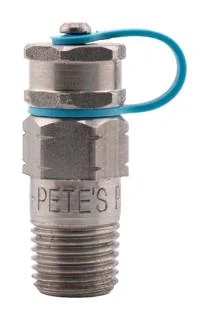
The Pete's Plug #400 features a stainless steel body, neoprene core, and 1/4" NPT connection.
A common choice for chilled water supply and return lines, pump suction and discharge, and strainer taps.
Need a BSP thread? Centro also offers the Pete's Plug #400BSP, with the same stainless steel body and neoprene core and a 1/4" BSP connection, for BSP-threaded equipment on non-glycol lines.
Pete's Plug #410BSP — 1/4" BSP Nordel Core Test Port
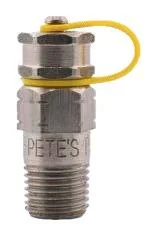
The Pete's Plug #410BSP features a stainless steel body, Nordel (EPDM) core, and 1/4" BSP connection.
A good fit for equipment built with BSP (British Standard Pipe) threads, which is common on equipment made outside North America, and for glycol systems.
Pete's Plug #800 — 1/2" NPT Test Port
The Pete's Plug #800 features a stainless steel body, neoprene core, and 1/2" NPT connection.
It's 1-1/2" long, rated to a maximum of 1,500 PSI, and rated to 200°F with the cap on (175°F with the cap off), with a blue strap for easy identification. The larger 1/2" NPT thread suits bigger mains and equipment tapped for 1/2" connections.
Pete's Plug #810 — 1/2" NPT Nordel Core Test Port
The Pete's Plug #810 features a stainless steel body, Nordel (EPDM) core, and 1/2" NPT connection.
It's 1-1/2" long, rated to a maximum of 1,500 PSI, and has a yellow strap to mark the Nordel core. The 1/2" NPT choice for glycol loops and warmer water, such as heat-recovery piping or liquid cooling return lines.
XL Test Ports for Insulated Pipe
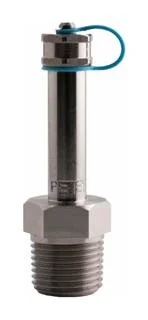
Insulated chilled water pipe? Use the XL versions. The #800XL (neoprene) and #810XL (Nordel) have the same 1/2" NPT thread and 316 stainless body, but a 3" overall length instead of 1-1/2". The longer body reaches through the pipe insulation, so the port stays accessible without cutting back the insulation and inviting condensation.
Which Pete's Plug Model Should You Use?
| Model | Thread | Core | Max Temp | Best For |
|---|---|---|---|---|
| #400 | 1/4" NPT | Neoprene | 200°F | Chilled water lines, pump and strainer taps |
| #400BSP | 1/4" BSP | Neoprene | 200°F | BSP-threaded equipment on non-glycol lines |
| #410BSP | 1/4" BSP | Nordel (EPDM) | 275°F | BSP-threaded equipment, glycol systems |
| #800 | 1/2" NPT | Neoprene | 200°F | Larger mains, equipment with 1/2" taps |
| #800XL | 1/2" NPT, 3" body | Neoprene | 200°F | Insulated chilled water pipe |
| #810 | 1/2" NPT | Nordel (EPDM) | 275°F | Glycol loops, warmer water |
| #810XL | 1/2" NPT, 3" body | Nordel (EPDM) | 275°F | Insulated glycol or warm water pipe |
Always verify pressure and temperature ratings, connection type, fluid compatibility, and manufacturer specifications before selecting a test port.
Where Are Pressure and Temperature Test Ports Used in Data Center Cooling Systems?
These are the test port locations that pay off most:
- Chilled water supply and return lines to compare operating temperatures and pressure readings.
- Pumps to help evaluate suction and discharge pressure.
- Heat exchangers to check inlet and outlet conditions and investigate potential restrictions.
- Strainers and filters to compare pressure readings and identify excessive pressure drop.
- Compatible facility water piping serving CDUs to help troubleshoot liquid cooling infrastructure.
The appropriate locations depend on the system design and should be determined by qualified personnel.
Keep Data Center Cooling Systems Operating Efficiently
Test ports are cheap to add during construction or a planned outage, and they pay for themselves the first time a server room runs hot. Instead of guessing, your team reads the actual pressure and temperature at the equipment in minutes and goes straight to the cause.
Frequently Asked Questions
What is a Pete's Plug?
A Pete's Plug® is a pressure and temperature (P/T) test plug made by Peterson Equipment Co., Inc. It threads permanently into a pipe and has two self-closing valve cores. A technician inserts a 1/8" OD gauge adapter or temperature probe to take a reading while the system stays pressurized, and the valves reseal when the probe comes out. Charles "Pete" Peterson Jr. invented the plug in 1965 and founded the company in 1969.
Which Pete's Plug is best for glycol systems?
Choose a Nordel (EPDM) core: the #810 (1/2" NPT), the #810XL for insulated pipe, or the #410BSP for BSP-threaded equipment. Nordel resists glycols and is rated to 275°F. Neoprene cores (#400, #800) are better suited to oils and refrigerants.
Where should P/T ports go on a CDU?
On the facility water supply and return piping feeding the CDU, as close to the unit as practical. Ports there let you read supply temperature, return temperature, and pressure drop to confirm the CDU is getting its design flow. Don't add fittings to the server-side coolant loop unless the CDU or server manufacturer approves it.
How do test ports help find low delta T problems?
Read the supply and return temperatures at each coil or CDU and compare the difference to the design delta T. Units running well below design are usually getting more water than they need, often because of a control valve stuck open, a fouled coil, or poor balancing. Checking unit by unit finds the problem faster than plant-level BMS data.
Do I need an XL test plug on insulated pipe?
Usually, yes. The #800XL and #810XL have a 3" body that extends through pipe insulation, so the cap stays accessible and you don't have to cut back insulation around the port. On chilled water lines, exposed fittings can sweat.
Can I take readings without shutting the system down?
Yes. Remove the cap, push the probe through the valve cores, take the reading, and pull it out. The valves close behind it, and you put the cap back on. Nothing is drained or isolated.
How can I tell a genuine Pete's Plug from an imitation?
Genuine Pete's Plugs have the Pete's Plug® name engraved on both the body and the cap. They're made and assembled by hand by Peterson Equipment in Katy, Texas, and more than 40 million have been sold worldwide.
Shop Pete's Plug Pressure and Temperature Test Ports at Centro
Centro offers Pete's Plug pressure and temperature test ports for industrial, HVAC, and data center cooling applications.
Explore our Pete's Plug #400, #400BSP, #410BSP, #800, and #810 products, or contact Centro for assistance finding the right test port for your cooling system.