
Automation and Robotics - ABB
What is Automation and Robotics?
Automation and Robotics involve leveraging technology to automate tasks and processes traditionally performed by people. This integration enhances efficiency ...

Safety switches are essential components within industrial safety systems, designed to prevent accidents and protect workers and equipment. These switches provide a reliable means of instantly interrupting power or triggering safety functions in response to hazardous conditions. Available in various configurations like limit switches, interlock switches, and emergency stop switches, they cater to a wide range of applications. Safety switches serve as critical control points, ensuring machinery halts promptly during emergencies or when unsafe conditions arise. Safety switches play a pivotal role in safeguarding workplaces and adhering to safety standards by offering fail-safe operation and compatibility with diverse environments. Their integration enhances operational safety, minimizes risks, and fosters secure industrial environments.

Safety accessories are crucial elements within industrial safety systems, enhancing the effectiveness of safety equipment and processes. These accessories include mounting brackets, enclosures, indicator lights, and reset keys. Safety accessories are designed to complement safety devices like switches, sensors, and controllers ensure proper installation, visibility, and ease of use. They support creating a comprehensive safety ecosystem that aligns with industry regulations and standards. By simplifying maintenance, improving visibility, and facilitating quick response actions, safety accessories contribute significantly to overall safety. Their integration elevates safety measures, minimizes risks, and fosters a secure industrial environment that prioritizes worker protection and equipment integrity.

Pull cords and emergency stops are critical components in industrial safety, providing direct and immediate means to halt machinery and prevent accidents. Pull cords are strategically placed along equipment or conveyors, allowing workers to quickly trigger a shutdown in emergencies. Emergency stops, often in the form of large buttons or switches, offer an instant way to halt operations if unsafe conditions arise. These safety mechanisms are designed for intuitive and rapid use, ensuring workers can react promptly to potential hazards. Pull cords and emergency stops are essential in creating a safe work environment, empowering workers to take control and prevent accidents. Their integration enhances workplace safety, reduces risks, and underscores the commitment to worker well-being and equipment protection.
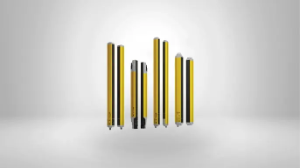
Light curtains are advanced safety devices that provide a protective shield for workers and equipment in industrial settings. Composed of an array of light beams, light curtains act as an invisible barrier, instantly detecting any intrusion or obstruction within their field. In situations where human-machine interaction is common, such as manufacturing and material handling, light curtains are crucial in preventing accidents and ensuring operator safety. These devices are designed to stop machinery or trigger alarms when they detect any breach in their protective zone. Light curtains are essential in creating safer work environments, reducing accidents, and increasing productivity by maintaining a harmonious balance between human workers and automated equipment.
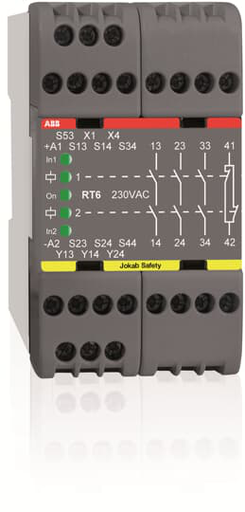
Safety controllers and relays are crucial pillars in industrial safety, offering advanced risk mitigation and equipment protection solutions. These specialized components are meticulously designed to monitor and manage safety-related processes, ensuring compliance with industry standards and regulations. Safety controllers oversee complex safety functions, while safety relays serve as trusted interfaces between safety devices and control systems. These controllers and relays contribute significantly to accident prevention and worker protection by swiftly detecting unsafe conditions and initiating appropriate responses. Their integration into safety-critical systems provides the foundation for safe operations across industries. With a focus on reliability, precision, and adherence to safety norms, safety controllers and relays create secure and productive environments, elevating workplace safety to new heights.
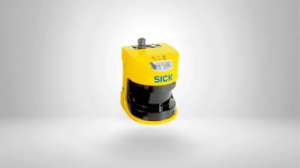
Safety control devices are safeguards in industrial settings, designed to protect both personnel and equipment from potential hazards. Discover our range of safety control devices or contact us to speak with a product expert.

Encoders are electromechanical devices used to convert mechanical motion or position into electrical signals. These devices provide feedback on the position, speed, or direction of rotating components, such as motors, shafts, or robotic joints. Encoders offer high accuracy and resolution, enabling precise control and positioning in industrial automation, robotics, CNC machines, or motion control systems. They are available in various types, including optical encoders, magnetic encoders, or capacitive encoders, providing options for different motion sensing requirements.

Safety sensors form the backbone of industrial safety, providing a proactive approach to accident prevention and worker protection. These sensors are meticulously engineered to detect potentially hazardous conditions, such as motion, presence, or environmental changes. Employed in applications from automated machinery to conveyor systems, safety sensors swiftly identify unsafe situations and trigger appropriate responses, such as stopping equipment or initiating alarms. With their advanced technology and diverse configurations, including light curtains, area scanners, and proximity sensors, safety sensors ensure compliance with safety standards and regulations. By seamlessly integrating into industrial processes, safety sensors foster a secure environment, minimize risks, and empower industries to prioritize the well-being of workers and equipment.
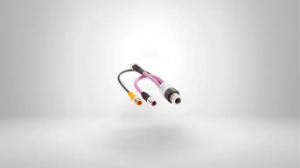
Sensor cables are specialized cables designed for connecting sensors to control systems or data acquisition devices. These cables provide the necessary electrical connections for transmitting power supply, signal, and data between the sensor and the target device. Sensor cables are often shielded to minimize interference and maintain signal integrity in noisy industrial environments. They come in different lengths, connector types, and specifications to accommodate various sensor configurations and connectivity requirements. Sensor cables ensure reliable and accurate data transmission from sensors to the control or monitoring systems.

RFID (Radio-Frequency Identification) is a cutting-edge technology transforming how businesses manage inventory, track assets, and enhance security. With RFID, small chips or tags can store and transmit data wirelessly, allowing for real-time industry monitoring and automation. These versatile devices are used in logistics, retail, healthcare, and more to improve efficiency, reduce errors, and streamline operations. RFID is ushering in a new era of data-driven decision-making and is at the forefront of the Internet of Things (IoT) revolution.

$301.70
Subject to factory lead times
$301.70
Subject to factory lead times
$301.70
Subject to factory lead times
$301.70
Subject to factory lead times
$316.70
Subject to factory lead times
$316.70
Subject to factory lead times
$371.54
Subject to factory lead times
$468.78
Subject to factory lead times
$468.78
Subject to factory lead times
$488.74
Subject to factory lead times
$488.74
Subject to factory lead times
$533.62
Subject to factory lead times
$301.70
Subject to factory lead times
$301.70
Subject to factory lead times
$301.70
Subject to factory lead times
$301.70
Subject to factory lead times
$316.70
Subject to factory lead times
$316.70
Subject to factory lead times
$371.54
Subject to factory lead times
$468.78
Subject to factory lead times
$468.78
Subject to factory lead times
$488.74
Subject to factory lead times
$488.74
Subject to factory lead times
$533.62
Subject to factory lead times
- Getting started with industrial automation begins with identifying the tasks that are repetitive, hazardous, labor-intensive, or quality-critical — these are the best candidates for automation. Common first steps include adding sensors for detection and feedback, installing pneumatic or electric actuators to replace manual movements, and using PLCs or smart relays to coordinate the sequence. For more advanced automation, industrial robots and collaborative robots (cobots) can handle pick-and-place, assembly, welding, palletizing, and packaging tasks with grippers and end-of-arm tooling (EOAT). Machine vision systems add inspection and quality control capabilities. Safety equipment — light curtains, safety switches, emergency stops, and guarding — is required to protect operators working near automated equipment. Centro's Automation and Robotics division offers products across all of these areas and can help you evaluate which tasks to automate first for the best return on investment.
- End-of-arm tooling (EOAT) refers to the device mounted on the end of a robotic arm that directly interacts with the workpiece — it is what allows the robot to grip, move, orient, and place parts. The most common EOAT type is the gripper, and selecting the right one depends on the workpiece material, shape, weight, and process requirements. Pneumatic grippers use compressed air and are the workhorse for general-purpose pick-and-place — they are fast, reliable, and available in parallel, angular, and three-finger configurations. Electric grippers use servo motors for programmable grip force and position, making them ideal for delicate or variable parts requiring precise control. Vacuum grippers use suction cups to handle flat, smooth, or irregularly shaped items like boxes, sheets, and glass without mechanical clamping. Magnetic grippers handle ferrous metal parts without contact mechanisms, offering quick cycle times for steel stamping and machining operations. Quick-change systems allow a single robot to swap between different EOAT types for multi-task flexibility.
- A collaborative robot — or cobot — is designed to work safely alongside human operators in a shared workspace without requiring safety fencing or caged enclosures. Cobots use built-in force and torque sensors, speed monitoring, and rounded, pinch-free designs to detect contact with a person and immediately stop or reverse motion, meeting ISO 10218 and ISO/TS 15066 safety standards. Traditional industrial robots operate at high speeds and forces behind safety guarding because they are not designed to detect or respond to human contact. Cobots are the right choice for applications that require human-robot interaction — tasks like machine tending, light assembly, quality inspection, and palletizing where an operator works nearby or hands off parts to the robot. They are also easier to program (often through hand-guiding or intuitive software), making them practical for small-batch and high-mix production where tasks change frequently. Traditional robots remain the better choice for high-speed, high-payload, or hazardous applications where human proximity is not needed.
- Industrial sensors detect physical conditions — presence, position, distance, temperature, pressure, level, and more — and convert them into electrical signals that PLCs and controllers use to make decisions. Selecting the right sensor starts with what you need to detect. Inductive proximity sensors detect metal objects at close range without contact and are the standard for detecting machine parts, cylinders at end-of-stroke, and metal targets on conveyors. Photoelectric sensors use light beams to detect objects at longer ranges and work on any material — through-beam, retroreflective, and diffuse types cover different range and mounting scenarios. Capacitive sensors detect both metallic and non-metallic materials including liquids, powders, and plastics, making them useful for level sensing through container walls. Ultrasonic sensors measure distance using sound waves, ideal for level measurement and position sensing of irregular surfaces. Beyond sensing type, consider the mounting environment — temperature, washdown exposure, vibration — and select the appropriate IP rating and housing material.
- Every automated or robotic work cell must include safety equipment to protect personnel from hazardous motion, in compliance with OSHA regulations and machine safety standards such as ANSI/RIA 15.06 and ISO 13849. The specific equipment depends on the risk assessment, but common components include safety light curtains that create an invisible detection field and stop the machine if a person enters the hazardous zone, safety laser scanners that monitor floor-level areas and can define warning and stop zones, safety interlock switches on access doors and gates that cut power when opened, emergency stop buttons placed within reach of operators, and safety-rated PLCs or safety relays that monitor all safety inputs and ensure the machine reaches a safe state before restarting. For collaborative robot applications, the cobot's built-in safety system may reduce the need for external guarding, but a thorough risk assessment is still required to determine whether additional measures — such as area scanners or reduced speed zones — are needed.