
NFPA Cylinders - Fabco-Air
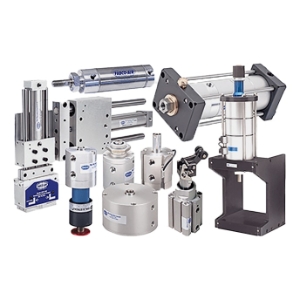
NFPA cylinders tailored for pneumatic systems adhere to the rigorous standards set by the National Fluid Power Association. These cylinders offer a robust, standardized solution for achieving efficient linear motion within pneumatic automation setups. With adherence to NFPA guidelines, these cylinders ensure compatibility, interchangeability, and easy integration across various manufacturers' components. In various sizes and configurations, NFPA pneumatic cylinders enable precise control and reliable performance in applications spanning manufacturing, packaging, and material handling. Their standardized design simplifies maintenance and replacement, making them a preferred choice for achieving streamlined automation and optimal productivity.
$199.84
Subject to factory lead times
$337.75
Subject to factory lead times
$205.15
Subject to factory lead times
$312.73
Subject to factory lead times
$241.23
Subject to factory lead times
$205.09
Subject to factory lead times
$210.03
Subject to factory lead times
$181.78
Subject to factory lead times
$207.94
Subject to factory lead times
$244.47
Subject to factory lead times
Subject to factory lead times
$226.39
Subject to factory lead times
$199.84
Subject to factory lead times
$337.75
Subject to factory lead times
$205.15
Subject to factory lead times
$312.73
Subject to factory lead times
$241.23
Subject to factory lead times
$205.09
Subject to factory lead times
$210.03
Subject to factory lead times
$181.78
Subject to factory lead times
$207.94
Subject to factory lead times
$244.47
Subject to factory lead times
Subject to factory lead times
$226.39
Subject to factory lead times
- An NFPA pneumatic cylinder is a heavy-duty, tie-rod construction air cylinder built to the dimensional and mounting standards defined by the National Fluid Power Association (NFPA). The NFPA standard specifies exact bore sizes, mounting dimensions, rod diameters, port sizes, and overall envelope dimensions so that cylinders from any NFPA-compliant manufacturer are dimensionally interchangeable. This means an NFPA cylinder from one manufacturer can be replaced with an NFPA cylinder from another manufacturer without modifying the mounting holes, piping connections, or machine structure. NFPA cylinders are the standard for heavy-duty industrial applications requiring high force, long stroke capability, and the assurance of multi-source interchangeability for maintenance and procurement flexibility.
- The primary advantage of NFPA cylinders is interchangeability — standardized dimensions guarantee that a replacement cylinder from any NFPA-compliant manufacturer will bolt directly into the existing mounting, connect to the existing piping, and interface with the existing rod connections without modification. This provides significant procurement advantages: you are not locked into a single manufacturer, you can source from multiple suppliers for competitive pricing and faster delivery, and maintenance personnel can stock common NFPA sizes that fit multiple machines from different OEMs. NFPA cylinders are also designed for repairability — the tie-rod construction allows complete disassembly for seal replacement and internal inspection, extending service life through multiple rebuild cycles. The heavy-duty construction with precision-honed bores, hard-chrome rods, and quality seal materials provides long, reliable service in demanding industrial environments.
- NFPA cylinders are available in standard bore sizes typically ranging from 1-1/2 inches to 8 inches (and larger in some product lines), covering force outputs from several hundred pounds to over 5,000 pounds at 100 PSI. Stroke lengths are available from fractions of an inch to several feet, with custom strokes commonly available. The NFPA standard defines multiple mounting styles, each identified by a standard code: head rectangular flange, cap rectangular flange, head square flange, cap square flange, side lug, side tapped, centerline lug, centerline tapped, head trunnion, cap trunnion, intermediate trunnion, clevis, and extended tie rod mounts, among others. This comprehensive range of standardized mounting options allows the same cylinder series to be installed in virtually any machine configuration.
- Choose an NFPA cylinder when the application requires any of the following: high force output (bore sizes 1-1/2 inches and larger with proportionally high forces), long stroke length (strokes beyond what compact or round body cylinders can reliably deliver), heavy-duty construction for demanding industrial environments (high cycle rates, high pressures, dirty or corrosive conditions), repairability (the ability to rebuild the cylinder with seal kits rather than replacing the entire unit), and multi-source interchangeability (the assurance that replacement cylinders from any manufacturer will fit without machine modifications). Choose compact or round body cylinders when the application involves lighter forces, shorter strokes, tighter space constraints, and the lower cost and lighter weight of these simpler designs is advantageous. In general, NFPA cylinders are the standard choice for primary machine functions in heavy industrial applications, while compact and round body cylinders handle lighter-duty auxiliary functions.
- NFPA cylinders are designed for field repair through complete disassembly and seal replacement. To rebuild: depressurize and disconnect all air lines. Remove the tie rods (the long bolts that hold the end caps to the barrel) and slide the end caps off the barrel. Remove the piston and rod assembly. Inspect the bore for scoring, scratching, or corrosion — minor surface imperfections can be honed, but deep damage may require barrel replacement. Inspect the rod for scoring, pitting, or chrome flaking — damaged rods should be replaced or rechromed. Replace all seals, O-rings, wear bands, and wipers with the correct seal kit for the cylinder model and bore size. Lubricate all seals during reassembly. Reassemble, torque tie rods to specification, reconnect air lines, and test. Establishing a preventive maintenance schedule based on cycle count or calendar intervals — rather than running to failure — minimizes unplanned downtime.