
Specialty Cylinders - Fabco-Air
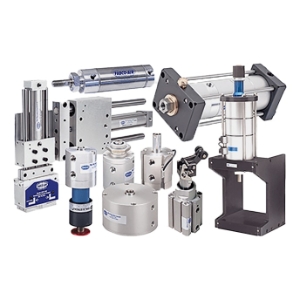
Specialty cylinders are unique and crucial in addressing specific requirements across diverse industries. These cylinders are designed for specialized applications, offering tailored solutions for tasks that standard cylinders cannot fulfill. From high-temperature environments to extreme loads, specialty cylinders are engineered to excel under challenging conditions. Whether it's a custom design, material, or configuration, these cylinders provide the precision and reliability necessary to meet the demands of niche applications. With their versatility and adaptability, specialty cylinders offer innovative solutions that drive efficiency and performance in specialized industrial settings.
$121.70$139.09
Subject to factory lead times
$121.70$139.09
Subject to factory lead times
$147.02$168.02
Subject to factory lead times
$147.02$168.02
Subject to factory lead times
$161.52$184.58
Subject to factory lead times
$161.52$184.58
Subject to factory lead times
$149.13$170.43
Subject to factory lead times
$149.13$170.43
Subject to factory lead times
$174.39$199.30
Subject to factory lead times
$174.39$199.30
Subject to factory lead times
$188.93$215.91
Subject to factory lead times
$188.93$215.91
Subject to factory lead times
$121.70$139.09
Subject to factory lead times
$121.70$139.09
Subject to factory lead times
$147.02$168.02
Subject to factory lead times
$147.02$168.02
Subject to factory lead times
$161.52$184.58
Subject to factory lead times
$161.52$184.58
Subject to factory lead times
$149.13$170.43
Subject to factory lead times
$149.13$170.43
Subject to factory lead times
$174.39$199.30
Subject to factory lead times
$174.39$199.30
Subject to factory lead times
$188.93$215.91
Subject to factory lead times
$188.93$215.91
Subject to factory lead times
- Specialty pneumatic cylinders are purpose-built actuators designed for specific applications or conditions that standard cylinders cannot adequately serve. Common types include sine cylinders (providing smooth sinusoidal acceleration for handling delicate products), load-stopping cylinders (safely decelerating moving loads at any stroke point), locking cylinders (mechanically locking the rod when air is removed for fail-safe holding), tandem cylinders (two pistons in series for double force in the same bore size), multi-position cylinders (stopping at three or more positions), and cylinders rated for extreme environments such as high temperature, corrosive, clean room, food-grade, or underwater applications.
- Food and beverage manufacturing uses FDA-compliant, washdown-rated stainless steel cylinders for daily high-pressure cleaning. Pharmaceutical and clean room manufacturing uses low-particle, specially sealed cylinders. Automotive and metalworking uses weld spatter-resistant cylinders in welding cells and high-temperature cylinders near furnaces. Semiconductor manufacturing uses ultra-clean, non-outgassing cylinders. Marine applications use corrosion-resistant cylinders rated for saltwater. Packaging of delicate products uses sine cylinders for smooth acceleration. Vertical lifting uses locking cylinders that hold loads if air pressure is lost, preventing dangerous drops.
- A tandem cylinder has two pistons connected in series on a common rod inside one body. Both are pressurized simultaneously, producing approximately double the force of a single-piston cylinder of the same bore size. Tandem cylinders are used when more force is needed than a single cylinder of the available bore can provide, but there is not enough space for a larger-bore cylinder. By doubling force without increasing bore diameter, it fits the same cross-sectional space while delivering next-larger-bore-size force. The trade-off is greater length. They are commonly used in pressing, clamping, and punching applications requiring high force in limited-diameter spaces.
- A locking cylinder has a built-in mechanical lock that clamps the piston rod in position when air is removed or lost. Standard cylinders allow the piston to move freely when pressure changes — if air is lost while supporting a raised load, the load falls. A locking cylinder prevents this with a spring-engaged, air-released mechanism: the lock is normally engaged by spring force and only releases when air pressure is applied to the lock port. This means the cylinder automatically locks on air loss, providing fail-safe holding. Locking cylinders are critical for vertical lifting, press applications requiring position holding during processes, and any application where uncontrolled motion from air loss could cause injury or damage.
- Consider a specialty cylinder when your application exceeds standard cylinder capabilities in these areas: Environmental conditions — extreme temperatures, corrosive chemicals, washdown, food contact, clean room, or underwater operation. Motion profile — smooth shock-free motion for delicate products (sine cylinder), mid-stroke stopping (multi-position), or load deceleration (load-stopping). Safety — supporting loads that could fall on air loss (locking cylinder) or operating in hazardous atmospheres. Force — needing more force than the largest bore that fits the space (tandem). Centro's product specialists can evaluate whether your application needs a specialty design or if a standard cylinder with accessories can meet the requirements.