
Control Valves - Fabco-Air
Control valves regulate the flow, pressure, and temperature of fluids in various industrial processes. These valves are essential for maintaining efficiency, safety, and precision in applications such as oil and ga...
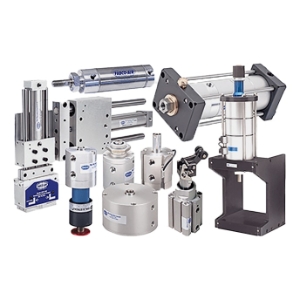
Directional control valves are essential components in fluid systems, managing the flow and direction of fluids in various applications. These valves enable precise control over fluid pathways, allowing for efficient actuation of cylinders, motors, and other devices. With diverse configurations such as solenoid-operated, manual, or mechanical, directional control valves offer versatility to meet different control needs. Whether for industrial machinery, automation, or hydraulic systems, these valves play a crucial role in optimizing fluid dynamics and operational efficiency.
$96.80
Subject to factory lead times
$96.80
Subject to factory lead times
- A control valve is a mechanical device used to regulate flow, pressure, temperature, or liquid level in a system. It automatically adjusts valve position in response to signals from a controller.
- Control valves receive a signal from a controller or sensor and modulate the valve opening to maintain desired process conditions such as flow rate or pressure.
- Common types include globe valves, ball control valves, butterfly control valves, diaphragm control valves, pinch valves, and angle valves.
- Control valves may use pneumatic, electric, or hydraulic actuators. Pneumatic actuators are common in industrial environments due to reliability and safety.
- Flow characteristic describes the relationship between the valve's stem position (% open) and the flow rate through it (% of maximum flow), and it determines how the valve responds as it opens. A linear flow characteristic means the flow rate is directly proportional to valve position — 50% open gives 50% flow, 25% open gives 25% flow. Linear valves are used in applications with a constant pressure drop where a proportional response is needed, such as liquid level control loops and some blending or batching applications. An equal-percentage flow characteristic means equal increments of valve travel produce equal percentage changes in flow — so at low openings, small position changes produce small flow changes, and at high openings, the same position changes produce much larger flow changes. This provides better control in applications where the pressure drop across the valve changes significantly with flow rate (which is the case in most industrial process loops), because the valve's increasing gain at higher openings compensates for the decreasing pressure drop. Equal percentage is the most commonly specified characteristic for process control applications because it provides the most stable control across the widest range of operating conditions.