
Instrumentation, Measurement and Control - NOSHOK
Instrumentation refers to devices that measure or control physical variables such as temperature, level, flow, or pressure. These products are essential in the industry because they allow for maximum output with mi...

Pressure transmitters, also known as pressure transducers, are instruments used to measure and transmit pressure readings as electrical signals. These devices convert pressure into an analog or digital signal, which can be utilized for monitoring, control, or data acquisition purposes. Pressure transmitters offer accurate and reliable pressure measurement in industrial processes, HVAC systems, manufacturing, and other applications. They provide real-time pressure information, enabling precise control, system optimization, and preventive maintenance.

Industrial gauges are versatile pressure measuring devices used in a wide range of industrial applications. They are designed to withstand demanding environments and provide accurate pressure readings for processes such as manufacturing, HVAC systems, hydraulic systems, and pneumatic systems. To suit different industrial requirements, industrial gauges are available in various sizes, pressure ranges, and connection types. They are known for their durability, resistance to vibration and shock, and ability to provide precise pressure measurements in industrial settings.
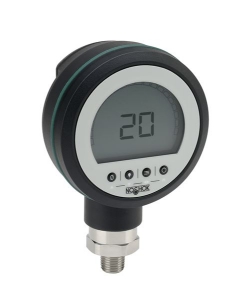
Digital gauges are instruments used to measure and display various parameters such as pressure, temperature, humidity, and flow in digital format. Digital gauges provide accurate readings and often feature digital displays for easy reading and data logging capabilities. Browse our selection below or contact us to speak with a product expert.

Process gauges are instruments explicitly designed for monitoring and measuring pressure in industrial processes. They are built to withstand harsh operating conditions, such as high temperatures, corrosive environments, or high pressure levels. Process gauges are commonly used in industries like oil and gas, chemical manufacturing, and power generation, where accurate and reliable pressure monitoring is crucial.

Commercial gauges are pressure gauges primarily used in commercial applications, such as retail, building management, and general-purpose industrial settings. These gauges are often designed for lower pressure ranges and standard environments. Commercial gauges can be found in applications such as HVAC systems, water supply systems, pneumatic tools, and process control in commercial buildings. They are cost-effective solutions for pressure monitoring needs in less demanding commercial environments.

Bimetal thermometers are widely used temperature measurement devices that employ a bimetallic strip to indicate temperature changes. These thermometers consist of two metal strips, typically made of different metals with different coefficients of thermal expansion, bonded together. The metals expand or contract at different rates as the temperature changes, causing the bimetallic strip to bend. This bending motion is then translated into a rotational movement displayed on a calibrated dial to indicate the temperature. Bimetal thermometers are known for their simplicity, durability, and cost-effectiveness. They are commonly used in various industries and applications requiring reliable temperature monitoring, such as HVAC systems, automotive, food processing, and industrial processes. Bimetal thermometers offer advantages such as wide temperature ranges, resistance to shock and vibration, and ease of installation. They are available in different sizes and configurations to suit specific application requirements. With their robust construction and accurate temperature indication, bimetal thermometers provide a reliable and cost-effective temperature measurement solution in various industrial and commercial settings.

Pressure transducers are devices used to convert pressure measurements into electrical signals. These transducers utilize various sensing technologies such as strain gauges, capacitive elements, or piezoresistive elements to measure the pressure of liquids or gases accurately. They are widely used in industrial, automotive, and HVAC applications for monitoring and controlling pressure. Pressure transducers offer benefits like high accuracy, fast response times, and compatibility with different pressure ranges. They provide valuable data for process control, safety monitoring, and system optimization.
Pressure gauges are instruments used to measure the pressure of fluids or gases in various industrial, commercial, and residential applications. They visually indicate the pressure levels, allowing operators to monitor and control processes effectively. Pressure gauges consist of a dial or digital display with a needle or numeric readout representing the pressure measurement in units such as PSI (pounds per square inch) or kPa (kilopascals). They typically feature a Bourdon tube, diaphragm, or other sensing elements that convert the applied pressure into a mechanical displacement, which is then displayed on the gauge. Pressure gauges are available in different types, including analog and digital, with varying accuracy levels and pressure ranges to suit specific application requirements. They are commonly used in oil and gas, manufacturing, HVAC, and automotive industries, where pressure monitoring is critical for operational safety, system performance, and quality control. Pressure gauges provide valuable feedback for adjusting process parameters, detecting leaks or anomalies, and ensuring the optimal functioning of equipment and systems.

Transmitters, in the context of sensors, refer to devices that convert the sensor's analog or digital output into a standardized electrical signal for transmission over long distances. They amplify, filter, and condition the sensor signal, ensuring accurate and reliable transmission to monitoring or control systems. Transmitters enable remote monitoring, data acquisition, or integration with control systems in various applications such as industrial automation, process control, or environmental monitoring. They play a crucial role in maintaining signal integrity, minimizing noise, and ensuring seamless communication between sensors and monitoring systems.

Pressure snubbers are small devices placed in-line with the pressure gauge to dampen sudden pressure fluctuations or pulsations. They help protect the gauge from damage caused by rapid pressure changes, thereby extending its lifespan and ensuring accurate and stable readings. Siphons, gauge cock valves, and pressure snubbers play crucial roles in pressure measurement systems by improving safety, accuracy, and the longevity of pressure gauges in various industrial applications.

Thermowells are protective enclosures or fittings that house temperature sensors in industrial processes. They provide a barrier between the sensor and the process media, protecting against corrosive fluids, high-pressure environments, or mechanical stresses. Thermowells facilitate easy sensor installation, replacement, or maintenance without interrupting the process. They ensure accurate temperature measurement and prolong the lifespan of temperature sensors, making them essential components in industries such as chemical processing, oil and gas, power generation, or food and beverage.

Panel meters and displays are instruments used to monitor and display various electrical or process parameters. They provide real-time measurement and visualization of parameters such as voltage, current, temperature, pressure, or flow rate. Panel meters and displays are available in different types, including analog meters, digital displays, or graphical interfaces, offering versatile options for different applications. They find extensive use in industrial control panels, machinery, electrical distribution systems, and monitoring stations, providing operators with crucial information for process control and troubleshooting.

Thermocouples and RTDs (Resistance Temperature Detectors) are types of temperature sensors widely used for temperature measurement in industrial processes, HVAC systems, or scientific research. Thermocouples consist of two dissimilar metal wires, generating a voltage proportional to the temperature difference between the sensing junction and the reference junction. RTDs, on the other hand, are temperature sensors with a defined resistance that changes with temperature. Thermocouples and RTDs offer accuracy, reliability, and compatibility with different temperature ranges and environmental conditions, providing precise temperature measurement in diverse applications.

Test gauges, also known as calibration gauges, are specialized instruments used to verify and calibrate the accuracy of other pressure measuring devices. They are typically manufactured with high precision and accuracy, ensuring reliable calibration results. Test gauges are often used in calibration laboratories, manufacturing facilities, and quality control processes to calibrate and validate the performance of pressure gauges and other pressure measurement instruments. These gauges are built to meet strict accuracy standards and can measure a wide range of pressure values, making them essential tools in maintaining the accuracy and reliability of pressure measurement equipment.
Pressure control accessories encompass a range of supplementary components and tools used to enhance the functionality, installation, or protection of pressure control systems. These accessories include pressure relief valves, pressure gauges, snubbers, manifolds, fittings, and connectors, among others. Pressure control accessories ensure proper system integration, accurate pressure measurement, secure connections, and protection against overpressure or contaminants. They play a crucial role in optimizing the performance, safety, and reliability of pressure control systems in various industries.

$4,896.84

$4,813.31

$4,861.75

$4,881.98

$4,874.39
Subject to factory lead times

$4,799.19

$4,815.46
Subject to factory lead times
$4,896.84
Subject to factory lead times
$4,813.31
Subject to factory lead times
$4,861.75
Subject to factory lead times
$4,881.98
Subject to factory lead times
$4,874.39
Subject to factory lead times
$4,799.19
Subject to factory lead times
$4,815.46
Subject to factory lead times
$4,896.84
Subject to factory lead times
$4,813.31
Subject to factory lead times
$4,861.75
Subject to factory lead times
$4,881.98
Subject to factory lead times
$4,874.39
Subject to factory lead times
$4,799.19
Subject to factory lead times
$3,652.32
$3,733.69
$3,650.16
$3,698.61
$4,896.84
$4,813.31
$4,861.75
$4,881.98
$4,874.39
Subject to factory lead times
$4,799.19
$4,815.46
Subject to factory lead times
$4,896.84
Subject to factory lead times
$4,813.31
Subject to factory lead times
$4,861.75
Subject to factory lead times
$4,881.98
Subject to factory lead times
$4,874.39
Subject to factory lead times
$4,799.19
Subject to factory lead times
$4,815.46
Subject to factory lead times
$4,896.84
Subject to factory lead times
$4,813.31
Subject to factory lead times
$4,861.75
Subject to factory lead times
$4,881.98
Subject to factory lead times
$4,874.39
Subject to factory lead times
$4,799.19
Subject to factory lead times
$3,652.32
$3,733.69
$3,650.16
$3,698.61
- Selecting the right process instrument starts with defining four things: what variable you need to measure (temperature, pressure, flow, or level), the process conditions the instrument will face (media type, temperature range, pressure range, corrosiveness, and whether the environment is hazardous), the accuracy and response time your application requires, and how the measurement data needs to be communicated (local display only, 4–20 mA signal to a PLC/DCS, or digital protocol like HART or Modbus). For temperature, the choice between thermocouples, RTDs, and infrared sensors depends on the temperature range and accuracy needed. For pressure, gauge type, range, wetted materials, and whether you need local indication or a remote transmitter signal are the key decisions. For flow, the fluid properties (conductive liquid, gas, steam, slurry) determine whether a magnetic, ultrasonic, Coriolis, vortex, or variable-area meter is the best fit. For level, vessel conditions (open vs. pressurized, clean liquid vs. foam/solids) guide the choice between float switches, ultrasonic, radar, or differential pressure technologies. Centro's instrumentation specialists can help you match the right technology to your specific process conditions and budget.
- Accurate process instrumentation is the foundation of safe, efficient, and compliant operations. Every control loop — whether it manages boiler pressure, reactor temperature, tank level, or pipeline flow — depends on instruments that provide reliable, real-time measurements. If a temperature sensor reads inaccurately, a heater may overshoot and damage the product or create a safety hazard. If a level transmitter drifts, a tank may overflow or run dry. If a flow meter is undersized, the control system cannot maintain the correct feed rate. Beyond safety and quality, accurate instrumentation directly impacts energy consumption, raw material usage, and regulatory compliance. Calibrated, properly specified instruments reduce waste, prevent unplanned shutdowns, and provide the data required for regulatory reporting and quality documentation.
- A process control loop is a system that continuously measures a process variable, compares it to a desired setpoint, and adjusts an output to keep the variable at the setpoint. The loop consists of three elements: the sensor/transmitter (measures the variable — e.g., a thermocouple measuring temperature), the controller (compares the measurement to the setpoint and calculates a corrective output — typically a PID controller), and the final control element (adjusts the process — e.g., a control valve that opens or closes to change steam flow). Instruments are the eyes and ears of the loop — without accurate, responsive sensors and transmitters, the controller cannot make correct decisions, and the process drifts out of specification. The entire loop must be properly engineered as a system — sensor accuracy, transmitter range, controller tuning, and valve sizing must all be matched to the process requirements.
- Industrial instruments communicate with controllers and PLCs using standardized electrical signals. The 4–20 mA analog current loop is the most widely used signal in process instrumentation — it transmits a variable measurement as a proportional current (4 mA = zero/low range, 20 mA = full scale), and the current-based signal is resistant to voltage drop and electrical noise over long cable runs. The 0–10 V DC voltage signal is used in some HVAC and building automation applications but is more susceptible to noise and cable length limitations. Discrete (on/off) signals — from switches, relays, and transmitter alarm contacts — indicate threshold conditions like high level, low pressure, or flow/no-flow. Digital communication protocols — HART (layered on top of 4–20 mA for configuration and diagnostics), Foundation Fieldbus, PROFIBUS PA, and IO-Link — enable bidirectional communication between the instrument and the control system for advanced diagnostics, remote configuration, and multi-variable data.
- When instruments are installed in locations classified as hazardous (areas where flammable gases, vapors, or combustible dusts may be present), they must be approved for that classification to prevent ignition. Key considerations include the area classification (Class I for gases/vapors, Class II for dusts, with Division 1 for normally present hazards and Division 2 for abnormal conditions — or Zone 0/1/2 under ATEX/IECEx), the protection method (intrinsic safety, explosion-proof, non-incendive, or purged/pressurized), and the specific gas group and temperature class. Intrinsically safe (IS) instruments — used with IS barriers in the safe area — limit energy to levels too low to cause ignition and are the most common and practical approach for low-power sensors and transmitters. Explosion-proof enclosures contain any internal explosion and are used for higher-power devices. Always verify the instrument's certification (FM, CSA, ATEX, IECEx) matches the area classification before installation.