
Guided Cylinders - Aventics
Guided cylinders are essential pneumatic components designed to provide precise and controlled linear motion in various industrial applications. Equipped with integrated guide rods or rails, these cylinders ensure ...
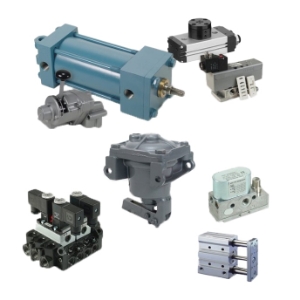
Pneumatic slides are essential mechanical components used in various industrial and automation applications. These devices harness compressed air to facilitate controlled linear motion, allowing objects or tools to rapidly move back and forth. Pneumatic slides are designed to be versatile and adaptable, making them suitable for tasks such as material handling, assembly, and positioning in manufacturing and automation processes. They are often equipped with features like adjustable stroke length, speed control, and robust construction to withstand demanding operating conditions. Pneumatic slides contribute to increased efficiency, repeatability, and accuracy in various industries, making them valuable for achieving streamlined and reliable mechanical motion in automated systems.
$237.66
Subject to factory lead times
$242.53
Subject to factory lead times
$247.71
Subject to factory lead times
$252.73
Subject to factory lead times
$257.90
Subject to factory lead times
$270.65
Subject to factory lead times
$283.24
Subject to factory lead times
$245.12
Subject to factory lead times

Subject to factory lead times
$308.79
Subject to factory lead times
Subject to factory lead times
$336.75
Subject to factory lead times
$348.55
Subject to factory lead times
$360.33
Subject to factory lead times
$372.13
Subject to factory lead times
Subject to factory lead times
Subject to factory lead times
$342.70
Subject to factory lead times
Subject to factory lead times
Subject to factory lead times
Subject to factory lead times
Subject to factory lead times
Subject to factory lead times
$350.90
Subject to factory lead times
$237.66
Subject to factory lead times
$242.53
Subject to factory lead times
$247.71
Subject to factory lead times
$252.73
Subject to factory lead times
$257.90
Subject to factory lead times
$270.65
Subject to factory lead times
$283.24
Subject to factory lead times
$245.12
Subject to factory lead times
Subject to factory lead times
$308.79
Subject to factory lead times
Subject to factory lead times
$336.75
Subject to factory lead times
$348.55
Subject to factory lead times
$360.33
Subject to factory lead times
$372.13
Subject to factory lead times
Subject to factory lead times
Subject to factory lead times
$342.70
Subject to factory lead times
Subject to factory lead times
Subject to factory lead times
Subject to factory lead times
Subject to factory lead times
Subject to factory lead times
$350.90
Subject to factory lead times
- Twin-rod guided cylinders use two guide rods parallel to the piston rod with linear bearings — the most common type providing good rigidity in a compact package. Slide-guided cylinders use flat slide bearings or linear rail systems for broader load support and higher moment resistance in a low-profile design. Heavy-duty guided cylinders use oversized guide rods and bearings for very high side loads. Precision guided cylinders use high-precision linear bearings and hardened guide rods for tight positional accuracy in applications like pick-and-place, pressing, and inspection. Low-profile guided cylinders minimize overall height. The choice depends on side-load magnitude, required accuracy, and available space.
- Pick-and-place operations use guided cylinders because offset tooling creates moment loads. Pressing and stamping use them for even force application without tilting. Assembly operations require stable, non-rotating motion for alignment. Clamping and workholding use them to apply force at specific points without rotation. Lifting and lowering platforms use them because distributed loads create moments. Testing and inspection fixtures use them for repeatable, accurate probe and sensor positioning.
- Guided cylinders distribute side loads across guide rod bearings instead of the piston rod seal. The guide rods and linear bearings form a larger, more rigid support structure than a single piston rod. Side loads on the load plate transfer through guide rods into the bearing block, where bearings absorb force across a larger surface area. The piston rod only carries axial thrust force and is isolated from side loads. This separation means piston rod seals operate under ideal conditions, dramatically extending seal life. Allowable side load depends on guide rod diameter, spacing, bearing type, and the distance between bearing and load application point.
- Both provide non-rotating, side-load-resistant linear motion but differ in precision. Pneumatic slides use precision-ground linear guide rails with ball or roller bearings providing extremely smooth travel, high rigidity, low deflection, and precise positioning. The flat table carriage provides a wide, stable mounting surface. Guided cylinders typically use round guide rods with sleeve or ball bushings providing good side-load resistance at lower precision and rigidity. For the highest positional accuracy, choose slides. For good guided motion at lower cost and more compact cross-section, guided cylinders are sufficient. Many engineers use slides for critical axes and guided cylinders for less critical functions.