
Cylinder Accessories - Fabco-Air
Pneumatic cylinder accessories are essential components that enhance the functionality and performance of pneumatic systems. These accessories include items like mountings, brackets, sensors, and fittings, which complement pneumatic cylinders to optimize their operations. By providing efficient mounting solutions, sensor integration for feedback, and suitable connections, these accessories contribute to seamless automation and precision control in various industrial applications.
Filter
Filter
107 items
content loaded
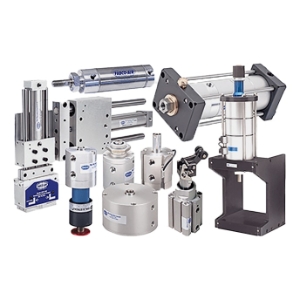
Fabco-Air component - #1221-HS-SKV
$27.98
Available for Purchase
Subject to factory lead times
Fabco-Air component - #321-SKGV-Q
$37.94
Available for Purchase
Subject to factory lead times
Fabco-Air component - #1221-HS-SKV
$27.98
Available for Purchase
Subject to factory lead times
Fabco-Air component - #321-SKGV-Q
$37.94
Available for Purchase
Subject to factory lead times
FAQS
- Pneumatic cylinder accessories are additional components that enhance cylinder functionality and integrate them into machine systems. Position sensing accessories include magnetic reed switches, Hall-effect sensors, and magnetoresistive sensors that mount on the cylinder body and detect the piston position through the wall to provide feedback to the PLC. Speed control accessories include flow control valves (meter-in and meter-out) and quick exhaust valves that regulate the air flow to and from the cylinder to control extension and retraction speed. Cushioning and shock absorption accessories include external shock absorbers and cushion sleeves that decelerate the piston at end of stroke to reduce impact and noise. Rod end accessories include floating joints, rod clevises, eye brackets, and alignment couplers that connect the rod to the load. Mounting accessories include brackets, flanges, foot mounts, and trunnion pins for attaching the cylinder to the machine structure.
- Position sensors mounted on pneumatic cylinders tell the machine controller (PLC) where the piston is located in the stroke, enabling the controller to confirm that the cylinder has completed its motion before commanding the next step in the machine sequence. Without position sensing, the controller must rely on time delays to estimate when the cylinder has finished moving — which is unreliable because cylinder speed varies with load, temperature, and air supply pressure. Position sensors eliminate guesswork by providing a positive electrical signal when the piston reaches a specific position. This prevents the machine from advancing the sequence before the cylinder has completed its stroke (which could cause collisions, misfeeds, or product defects), reduces cycle time by eliminating unnecessary time delays, and provides diagnostic information — if a sensor does not trip within the expected time, the controller can flag a fault and stop the machine before damage occurs.
- Flow control valves regulate the air flow rate to and from a pneumatic cylinder to control the speed of piston movement. Meter-out flow control valves restrict the air flowing out of the cylinder (the exhaust air) while allowing unrestricted flow in — this is the standard and preferred method for controlling cylinder speed because the trapped air on the exhaust side creates a cushioning backpressure that provides smooth, controlled motion. Meter-in flow control valves restrict the air flowing into the cylinder while allowing free exhaust — this method is less stable because there is no backpressure to resist the load, which can cause jerky or uncontrolled motion, especially with varying loads. Quick exhaust valves are mounted directly on the cylinder port and provide a large, unrestricted exhaust path to maximize cylinder speed when fast motion is the priority. The correct combination of flow controls on each port gives the operator precise control over both the extend and retract speeds independently.
- Cylinder cushions and shock absorbers decelerate the piston as it approaches the end of its stroke, reducing impact forces, noise, and vibration. Internal cushions (also called air cushions or built-in cushions) are designed into the cylinder — a cushion nose on the piston enters a reduced-diameter bore near the end cap, trapping a pocket of air that compresses and slows the piston before it reaches the end. Most quality industrial cylinders include adjustable internal cushions with needle valve adjustments to fine-tune the deceleration rate. External shock absorbers are separate hydraulic or pneumatic dampers mounted at the end of travel that the cylinder rod or load contacts — they provide more precise and higher-energy deceleration than internal cushions and are used for high-speed, high-mass applications. Cushion sleeves and bumpers are simple elastomer pads that reduce metal-to-metal impact and noise for lighter-duty applications. Proper cushioning extends cylinder life, reduces machine noise, and prevents damage to the workpiece and tooling.
- Rod end accessories connect the piston rod to the driven load and accommodate alignment and connection requirements. Rod clevises are U-shaped brackets with a pin hole that attach to the rod end for pivot connections to levers and linkages. Rod eye brackets are ring-type connectors for pin-to-pin linkage connections. Floating joints accommodate angular and radial misalignment between the rod and the driven mechanism, preventing side-loading on the cylinder seals. Alignment couplers connect the rod to the load while absorbing slight misalignment. Spherical rod end bearings allow multi-axis angular misalignment. Magnetic couplings provide non-contact load connection for clean or sealed environments. The correct rod end accessory ensures clean force transfer without introducing side loads or bending moments that would damage the cylinder's internal components. Centro carries a full selection of rod end accessories for pneumatic cylinders.