
Linear Cylinders - Fabco-Air
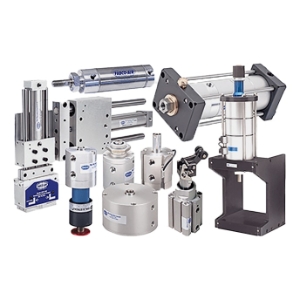
Centro offers linear cylinders, also known as linear actuators or hydraulic/pneumatic cylinders, which are mechanical devices that convert energy into linear motion. They are widely used in various industries, including manufacturing, automation, construction, and transportation. Linear cylinders consist of a piston or plunger that moves back and forth within a cylindrical housing, generating linear force and motion. These cylinders are powered by hydraulic fluid or compressed air, which is supplied to one side of the cylinder to push the piston in one direction, while the other side vents or returns the fluid to complete the cycle. Linear cylinders come in different designs, such as single-acting (one-directional force) and double-acting (bi-directional force). They offer precise control over linear movement, allowing for precise positioning, lifting, pushing, pulling, and clamping applications. Linear cylinders are essential in various industrial processes, such as material handling, machine tooling, assembly lines, and heavy equipment operations. With their robust construction, reliable performance, and versatility, linear cylinders enable efficient and controlled linear motion in various applications.
Subject to factory lead times
Subject to factory lead times
Subject to factory lead times
Subject to factory lead times
Subject to factory lead times
Subject to factory lead times
Subject to factory lead times
Subject to factory lead times
Subject to factory lead times
Subject to factory lead times
Subject to factory lead times
Subject to factory lead times
Subject to factory lead times
Subject to factory lead times
Subject to factory lead times
Subject to factory lead times
Subject to factory lead times
Subject to factory lead times
Subject to factory lead times
Subject to factory lead times
Subject to factory lead times
Subject to factory lead times
Subject to factory lead times
Subject to factory lead times
- A pneumatic linear cylinder (also called an air cylinder) is an actuator that uses compressed air to produce straight-line (linear) motion and force. It consists of a cylindrical bore (barrel), a piston that slides inside the bore, and a piston rod attached to the piston that extends through one end of the cylinder. When compressed air is directed into the cylinder on one side of the piston, the pressure acts on the piston area to create a force that pushes the piston and rod in a straight line. In a double-acting cylinder, air can be applied to either side of the piston to produce force in both the extend and retract directions. In a single-acting cylinder, air drives the piston in one direction and a spring returns it in the other. The force output depends on the bore size (piston area) and the air supply pressure — larger bores and higher pressures produce more force. Compact Automation linear cylinders available through Centro are offered in bore sizes from 3/4 inch to 8 inches, producing forces up to 5,030 pounds at 100 PSI, constructed of anodized aluminum with various mounting, rod end, and sensor options.
- A single-acting pneumatic cylinder uses compressed air to drive the piston in one direction (typically extend) and relies on an internal spring to return the piston in the opposite direction when air is exhausted. Single-acting cylinders require only one air line and a 3/2-way directional valve, making the pneumatic circuit simpler. However, the spring consumes some of the available force (the air must overcome the spring force in the power stroke), and the return stroke force is limited to the spring force. Single-acting cylinders are used for simple applications like clamping, ejecting, and pressing where force is needed in only one direction. A double-acting pneumatic cylinder uses compressed air on both sides of the piston — one port drives the piston forward (extend) and the other drives it backward (retract), with full air-powered force available in both directions. Double-acting cylinders require two air lines and a 5/2-way directional valve. They are the most common type used in industrial automation because they provide powered motion and force control in both directions, which is needed for most machine functions.
- The bore size determines the cylinder's force output at a given air pressure. To select the right bore size, first calculate the force needed to perform the work — this includes the force to move the load (weight times friction coefficient for horizontal motion, or weight for vertical lifting), any process force (pressing, clamping, punching), acceleration force (to bring the load up to speed within the available time), and any additional friction or resistance in the mechanism. Add a safety factor (typically 25-50% above the calculated force) to ensure reliable operation. Then calculate the bore size needed: Force = Pressure × Piston Area, so Piston Area = Force ÷ Pressure. From the piston area, calculate the bore diameter. Select the next standard bore size that meets or exceeds the required area. Standard bore sizes from Compact Automation available through Centro range from 3/4 inch to 8 inches. Always verify that the selected cylinder fits the available space and that the mounting and rod end configurations are compatible with the machine design.
- Pneumatic linear cylinders are available in numerous mounting styles to accommodate different machine designs and load orientations. Fixed mounts hold the cylinder body rigidly in place — these include nose mounting (threaded or flanged at the rod end), tail mounting (at the cap end), foot mounting (L-brackets or base plates bolted to the machine frame), and flange mounting (front or rear). Fixed mounts are used when the cylinder pushes or pulls in a straight line with no angular misalignment. Pivot mounts allow the cylinder body to swing in an arc as it operates — these include trunnion mounting (pivot pins on the sides of the cylinder), clevis mounting (a U-bracket at the cap end), and spherical bearing mounts. Pivot mounts are used when the cylinder drives a lever, linkage, or any mechanism where the load path changes angle as the cylinder extends. The correct mounting style depends on the application's load direction, whether the cylinder needs to pivot during operation, available space, and how the cylinder interfaces with the machine structure. Centro carries cylinders configurable with a wide variety of mounting styles.
- Repairable pneumatic cylinders are designed so that the internal wear components (piston seals, rod seals, piston, and rod bearing) can be accessed and replaced when they wear out, extending the cylinder's service life through multiple rebuild cycles. They typically have a tie-rod or threaded body construction that can be disassembled, and replacement seal kits are available from the manufacturer. Repairable cylinders are the standard choice for heavy-duty, high-cycle, or critical applications where the cylinder is expected to operate for years and periodic maintenance is more economical than replacement. Non-repairable pneumatic cylinders are constructed so that the body cannot be easily disassembled for internal repairs — when the seals wear out, the entire cylinder is replaced. They are typically smaller, lighter, and less expensive than repairable cylinders, constructed with stainless steel tubing and aluminum heads. Compact Automation offers non-repairable cylinders in bore sizes from 5/16 inch to 3 inches with forces up to 700 pounds at 100 PSI. Non-repairable cylinders are the standard choice for lighter-duty applications, smaller bore sizes, and installations where the lower initial cost and compact size outweigh the long-term economics of rebuild capability.