
Mounting - Numatics
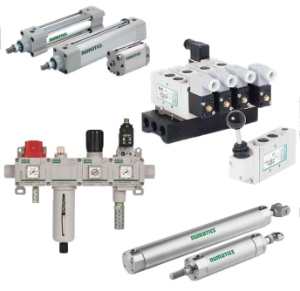
Pneumatic cylinders and actuator mounts are essential for industrial automation, enabling precise mechanical motion using compressed air. Pneumatic cylinders harness compressed air's power to generate linear or rotary movement for tasks like lifting and pushing. Actuator mounts, on the other hand, ensure the stable positioning and alignment of these cylinders within a system, optimizing their functionality. Together, these components are integral in industries such as manufacturing and automation, where they contribute to the efficient and controlled execution of various tasks, enhancing productivity and precision.
Filter
Filter
2 items
content loaded
MOUNTING BRACKET(L)
$5.34$6.62
Available for Purchase
Subject to factory lead times
MOUNTING BRACKET(S)
$5.34$6.62
Available for Purchase
Subject to factory lead times
MOUNTING BRACKET(L)
$5.34$6.62
Available for Purchase
Subject to factory lead times
MOUNTING BRACKET(S)
$5.34$6.62
Available for Purchase
Subject to factory lead times
FAQS
- Pneumatic cylinder mounting accessories provide the hardware needed to attach cylinders to machine frames, fixtures, and structures in the correct orientation and alignment for the application. Common mounting accessories include foot brackets (L-shaped brackets that bolt to the cylinder body and to the machine base for bottom or side mounting), flange plates (flat plates with bolt patterns for front or rear flange mounting), trunnion pins and bearings (pivot hardware for trunnion-mounted cylinders that need to swing during operation), clevis brackets (U-shaped brackets that attach to the rod end or cap end for pivot connections to levers and linkages), rod clevises and rod eye brackets (that attach to the piston rod end for pin connections to the driven mechanism), swivel joints and alignment couplers (that accommodate slight misalignment between the cylinder rod and the load), and mounting rails and base plates for securing cylinders in specific positions. The correct mounting accessories depend on the cylinder type and size, the load direction and alignment, whether the cylinder needs to pivot, and the machine structure to which it is being attached.
- The right mounting style depends primarily on the load alignment and whether the cylinder needs to pivot during operation. If the load moves in a straight line and the cylinder pushes or pulls directly in line with the load path, use a fixed mount (foot mount, flange mount, or nose mount) that holds the cylinder body rigid. Nose or front flange mounts are preferred when the cylinder pushes a load that requires the thrust force to be aligned with the front of the cylinder. Rear or cap-end mounts are preferred when the cylinder pulls a load. If the load moves in an arc or the connection between the cylinder and the load changes angle as the cylinder extends (such as when the cylinder drives a lever, hinge, or linkage), use a pivot mount (trunnion, clevis, or spherical bearing) that allows the cylinder body to swing and follow the arc of motion. Using a fixed mount in an application that requires pivoting will cause side-loading on the piston rod, leading to premature seal and bearing wear, rod bending, and reduced cylinder life. Using a rod clevis or rod eye at the rod end in combination with a trunnion or clevis at the body ensures both ends can pivot freely.
- Side-loading is a force applied perpendicular (sideways) to the piston rod of a pneumatic cylinder, rather than along its axis. Side loads cause the rod to bend, the piston and rod seals to wear unevenly, the rod bearing to overload on one side, and ultimately premature cylinder failure. Side-loading occurs when the cylinder is misaligned with the load path, when the load shifts laterally during the stroke, or when the connection between the rod and the load constrains the rod at an angle. Mounting accessories prevent side-loading in several ways: swivel joints and alignment couplers at the rod end accommodate angular misalignment between the rod and the driven mechanism. Rod clevises and eye brackets provide pin connections that allow the rod end to pivot rather than transmitting lateral forces into the rod. Trunnion and clevis body mounts allow the entire cylinder to pivot and follow the load path. Guide rods and external guides (used in guided cylinder designs) absorb side loads externally so they do not reach the piston rod seals. Proper mounting accessory selection and alignment during installation are the most important steps in ensuring long cylinder life.
- Rod end attachments are the hardware that connects the piston rod to the driven load or mechanism. The choice of rod end attachment directly affects alignment, load transfer, and cylinder life. Common rod end attachments include male threaded rod ends (the standard configuration — the piston rod has external threads that screw into the driven mechanism or into a coupling), female threaded rod ends (the rod has an internal threaded hole), rod clevises (a U-shaped bracket pinned to the rod for pivot connections), rod eye brackets (a ring-type connection for pin-to-pin linkages), floating joints (that accommodate angular and radial misalignment between the rod and the driven point), magnetic rod ends (for non-contact load coupling in clean or sealed environments), and spherical rod ends (bearing-type rod ends that accommodate multi-axis angular misalignment). The correct rod end attachment ensures that forces transfer cleanly from the rod to the load without introducing side loads, bending moments, or misalignment stresses that would damage the cylinder's internal seals and bearings.
- In most cases, yes. Many pneumatic cylinder designs are modular, with standardized mounting features on the body that accept different mounting accessories. For example, a cylinder with tapped holes or tie-rod nuts on the body can accept foot brackets, flange plates, or trunnion mounts by simply bolting the appropriate accessory to the existing body features. This modularity allows the same cylinder to be adapted to different machines and mounting configurations without purchasing a different cylinder model. Similarly, the rod end attachment can usually be changed by threading a different rod end coupling, clevis, or eye bracket onto the rod's threaded end. This is particularly useful when repurposing cylinders from one application to another or when changing the machine design. However, always verify that the new mounting arrangement properly supports the cylinder weight and the operating forces, that the alignment is correct to avoid side-loading, and that the mounting hardware is rated for the application loads. Centro's product specialists can help identify the correct mounting accessories for your specific cylinder and application.