
Pneumatic Cylinders and Actuators - Numatics
Pneumatic cylinders and actuators are used in a variety of industrial applications. Pneumatic cylinders and actuators use compressed air to create a force in a linear or rotary motion. Pneumatic cylinders come in ...
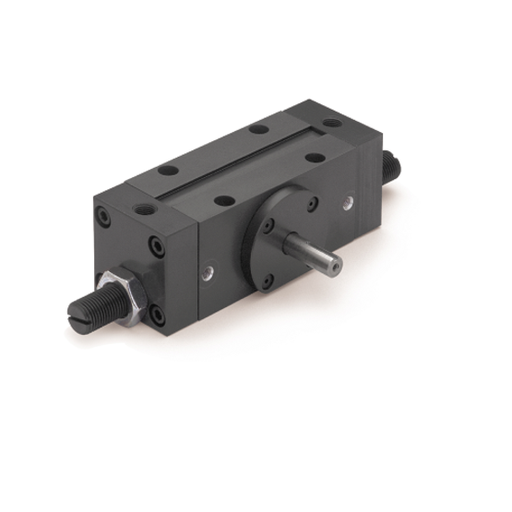
Rotary actuators are mechanical devices that convert energy into rotational motion, providing controlled movement and positioning in various applications. These actuators are designed to generate rotary force and torque to actuate valves, dampers, robotic arms, and other mechanisms requiring rotational motion. Rotary actuators can operate in different ways, including pneumatic, hydraulic, or electrically powered systems. They offer precise and reliable rotational control, allowing for accurate positioning and adjustment of components. Rotary actuators find applications in manufacturing, automotive, aerospace, and robotics industries, where precise and controlled rotary motion is crucial for efficient operations.

Guided cylinders are essential pneumatic components designed to provide precise and controlled linear motion in various industrial applications. Equipped with integrated guide rods or rails, these cylinders ensure stability and alignment during operation, reducing lateral movement and enhancing accuracy. Guided cylinders excel in applications where precise positioning and repeatability are critical, such as material handling, assembly, and automation. By offering dependable guidance and controlled motion, guided cylinders contribute to improved efficiency, reduced wear, and enhanced overall performance in diverse industrial settings.

Swing clamps are pneumatic or hydraulic clamps widely used in various industrial applications for secure and efficient workpiece clamping. These clamps are designed with a swinging arm mechanism that allows them to rotate or swing into position for clamping and release. Swing clamps offer versatility in their operation as they can be mounted in different orientations, such as vertically, horizontally, or at an angle, to accommodate diverse workpiece configurations. They provide a solid clamping force, enabling reliable holding and stability during machining, assembly, or welding. Swing clamps are particularly favored for their fast and precise clamping action, which reduces cycle times and enhances productivity. They are commonly utilized in automotive manufacturing, aerospace, machining centers, and assembly lines, where quick and efficient clamping is required. With their flexibility, robust construction, and reliable performance, swing clamps are crucial in improving workpiece handling, productivity, and overall operational efficiency in industrial settings.
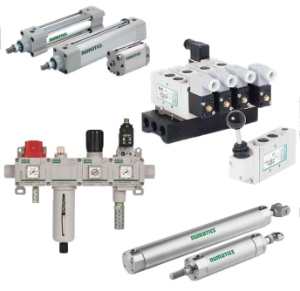
Seals and repair kits are indispensable for various mechanical systems and equipment maintenance and repair operations. Seals, which come in a wide range of materials and designs, are critical for preventing leaks and maintaining the integrity of hydraulic, pneumatic, and mechanical systems. These seals effectively block the escape of fluids, such as oil or gas, and play a vital role in ensuring system efficiency and longevity. Repair kits are curated collections of replacement parts, including seals, gaskets, O-rings, and other essential components. They are designed to simplify the repair and maintenance process by providing all the necessary parts in one package, facilitating quick and cost-effective fixes. Whether it's a hydraulic system in heavy machinery or a simple household appliance, seals and repair kits are crucial for ensuring the reliability and longevity of mechanical systems by preventing leaks and facilitating efficient repairs.
Pneumatic slides are essential mechanical components used in various industrial and automation applications. These devices harness compressed air to facilitate controlled linear motion, allowing objects or tools to rapidly move back and forth. Pneumatic slides are designed to be versatile and adaptable, making them suitable for tasks such as material handling, assembly, and positioning in manufacturing and automation processes. They are often equipped with features like adjustable stroke length, speed control, and robust construction to withstand demanding operating conditions. Pneumatic slides contribute to increased efficiency, repeatability, and accuracy in various industries, making them valuable for achieving streamlined and reliable mechanical motion in automated systems.
Air bellows are crucial components in pneumatic systems, providing a flexible and efficient means of generating linear motion or force. These bellows utilize compressed air to expand and contract, creating reciprocating movement that can be harnessed for various applications, such as actuation, dampening, or vibration control. With their ability to convert air pressure into mechanical motion, air bellows play a key role in diverse industries, from manufacturing to automation. Their reliable performance and adaptability make them essential for achieving controlled and precise movement in pneumatic setups.
Pneumatic cylinders and actuator mounts are essential for industrial automation, enabling precise mechanical motion using compressed air. Pneumatic cylinders harness compressed air's power to generate linear or rotary movement for tasks like lifting and pushing. Actuator mounts, on the other hand, ensure the stable positioning and alignment of these cylinders within a system, optimizing their functionality. Together, these components are integral in industries such as manufacturing and automation, where they contribute to the efficient and controlled execution of various tasks, enhancing productivity and precision.
Pneumatic directional control valves are pivotal components within pneumatic systems, responsible for determining the path of compressed air flow and subsequently controlling the movement of actuators. These valves govern the direction in which air travels, enabling the activation and deactivation of pneumatic cylinders or other actuators that perform mechanical tasks. With the ability to switch between multiple ports, pneumatic directional control valves facilitate intricate automation processes, allowing machinery to execute precise movements and sequences. Whether in manufacturing lines, robotics, or other industrial settings, these valves are indispensable for achieving efficient and accurate motion control, contributing to enhanced productivity and streamlined operations.
$644.83
Subject to factory lead times
$1,435.59
Subject to factory lead times
$835.10
Subject to factory lead times
Subject to factory lead times
$1,061.66
Subject to factory lead times
Subject to factory lead times

$1,709.93
Subject to factory lead times
$2,577.63
Subject to factory lead times
$1,205.69
Subject to factory lead times
$2,635.33
Subject to factory lead times
$830.10
Subject to factory lead times
$1,449.06
Subject to factory lead times
$644.83
Subject to factory lead times
$1,435.59
Subject to factory lead times
$835.10
Subject to factory lead times
Subject to factory lead times
$1,061.66
Subject to factory lead times
Subject to factory lead times
$1,709.93
Subject to factory lead times
$2,577.63
Subject to factory lead times
$1,205.69
Subject to factory lead times
$2,635.33
Subject to factory lead times
$830.10
Subject to factory lead times
$1,449.06
Subject to factory lead times
- Pneumatic actuators are simple, lightweight, and deliver high force relative to their size. They tolerate harsh environments, require no heat management, and are inherently safe in explosive atmospheres. Their limitations are lack of precise positioning, air compressor dependency, and energy inefficiency — compressed air is one of the most expensive utilities in a plant to generate. Electric actuators offer precise, programmable positioning, easy integration with control systems, and better energy efficiency. They are better suited for variable speed, multi-position, and data-driven applications. Their drawbacks are higher upfront cost, heat generation in continuous duty, and reduced suitability for wet or hazardous environments without special enclosures. As a rule: pneumatic for simple, fast, high-force end-to-end motion; electric for precision, programmability, and variable positioning.
- Pneumatic actuators convert compressed air energy into mechanical motion. In a linear actuator, compressed air enters one side of a cylinder, pressurizing the piston face and generating a force equal to pressure multiplied by piston area. That force pushes the piston and rod along the cylinder bore. In a double-acting cylinder, air alternately pressurizes each side to drive both extension and retraction. In a single-acting cylinder, air drives one direction and a spring or gravity returns the piston. Rotary pneumatic actuators — rack-and-pinion or vane types — convert air pressure into torque to open valves or rotate components. Speed is controlled by metering the airflow in or out of the cylinder with flow control valves.
- Several designs address tight installation envelopes. Compact or short-stroke cylinders reduce overall length by shortening the body profile while maintaining full bore force. Pancake cylinders have an extremely short body-to-stroke ratio and mount flat against surfaces — ideal when stroke requirements are minimal. Rodless cylinders eliminate the extending rod entirely, keeping the total installation length equal to stroke plus body length rather than double that of a rod cylinder. Guided compact units combine a cylinder and linear guide in a single body, removing the need for a separate guide rail. Rotary actuators replace linear motion entirely where a pivot or rotation serves the same function, often fitting in far less space than an equivalent linear device.
- For heavy lifting, the actuator type depends on whether the motion is linear or rotary and whether pneumatic or hydraulic power is available. Large-bore pneumatic cylinders generate substantial force — a 4-inch bore cylinder at 100 psi produces over 1,200 lbf — and are practical for moderate heavy-duty applications. For very high forces, hydraulic cylinders are the superior choice, operating at pressures of 1,500 to 5,000 psi and generating forces that compressed air cannot match in an equivalent cylinder size. For electric heavy lifting, high-force servo electric actuators with ballscrew or roller screw drives handle loads from hundreds to tens of thousands of pounds with precise control. Regardless of type, always factor in load eccentricity, duty cycle, and mounting configuration — off-axis loading and continuous cycling degrade any actuator far faster than rated static force figures suggest.
- The primary advantage of a rodless cylinder is space efficiency — the actuator's total installed length equals the stroke plus body length, rather than the stroke plus body length plus rod extension of a conventional cylinder. This makes them ideal for long-stroke applications in confined spaces. They also inherently resist side loading because the carriage rides along the cylinder body, distributing loads more evenly than a cantilevered rod. The main disadvantages are lower maximum operating pressure compared to rod cylinders, greater sensitivity to contamination along the external slot or band that transmits force, and higher cost and complexity. The internal sealing band or magnetic coupling that transfers force through the cylinder wall is the most maintenance-sensitive component and requires a clean operating environment to achieve full service life.
- Pneumatic actuators have fewer components but depend heavily on air quality. The most common failure points are seal wear from contaminated or unlubricated air, and corrosion from moisture in the supply. A disciplined filter-regulator-lubricator maintenance program — inspecting and draining moisture separators, replacing filter elements, and maintaining lubricator oil levels — prevents the majority of pneumatic failures. Seals and cushioning pads are the primary wear items requiring periodic replacement. Electric actuators require less routine consumable maintenance but have more complex failure modes — motor windings, encoder feedback devices, drive electronics, and mechanical drivetrain components (ballscrews, gearboxes, couplings) all require attention. Ballscrew lubrication and periodic backlash checks are the most common maintenance tasks. Electric actuator failures tend to be less predictable and more expensive to repair than worn pneumatic seals, making condition monitoring and scheduled inspection more important.
- Guided linear actuators integrate a drive cylinder with a precision linear guide to handle side loads and moment loads that a plain rod cylinder cannot resist. Twin-rod guided cylinders use two parallel rods through the end caps to prevent rotation and resist transverse loading — simple, robust, and widely used for pick-and-place and pressing applications. Slide-type guided units mount the carriage on profiled rail bearings for higher load capacity and rigidity, suitable for heavier tooling and multi-axis gantry systems. Compact guided cylinders combine the guide and drive in a low-profile square body, prioritizing space efficiency over maximum load rating. Rodless guided actuators use a magnetically or mechanically coupled external carriage on a rail, offering long stroke in minimal floor space. Electric linear actuators with integrated rail guides provide all of the above with programmable positioning and force control for the most demanding precision automation tasks.