
Seal and Repair Kits - Numatics
Seals and repair kits are indispensable for various mechanical systems and equipment maintenance and repair operations. Seals, which come in a wide range of materials and designs, are critical for preventing leaks ...
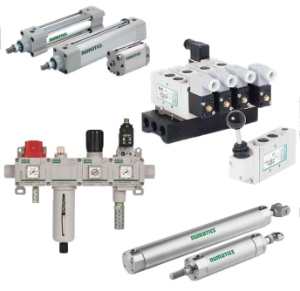
Pneumatic directional control valves are pivotal components within pneumatic systems, responsible for determining the path of compressed air flow and subsequently controlling the movement of actuators. These valves govern the direction in which air travels, enabling the activation and deactivation of pneumatic cylinders or other actuators that perform mechanical tasks. With the ability to switch between multiple ports, pneumatic directional control valves facilitate intricate automation processes, allowing machinery to execute precise movements and sequences. Whether in manufacturing lines, robotics, or other industrial settings, these valves are indispensable for achieving efficient and accurate motion control, contributing to enhanced productivity and streamlined operations.
Subject to factory lead times
Subject to factory lead times
$408.63
Subject to factory lead times
$345.87
Subject to factory lead times
$1,953.00
Subject to factory lead times
$958.02
Subject to factory lead times
$482.58
Subject to factory lead times
$827.56
Subject to factory lead times
$472.92
Subject to factory lead times
$492.17
Subject to factory lead times
$2,383.58
Subject to factory lead times
$1,188.13
Subject to factory lead times
Subject to factory lead times
Subject to factory lead times
$408.63
Subject to factory lead times
$345.87
Subject to factory lead times
$1,953.00
Subject to factory lead times
$958.02
Subject to factory lead times
$482.58
Subject to factory lead times
$827.56
Subject to factory lead times
$472.92
Subject to factory lead times
$492.17
Subject to factory lead times
$2,383.58
Subject to factory lead times
$1,188.13
Subject to factory lead times
- A pneumatic cylinder seal and repair kit is a pre-packaged set of all the replacement seals, O-rings, wear bands, and other soft components needed to rebuild a pneumatic cylinder and restore it to like-new performance. Over time, the seals inside a pneumatic cylinder wear due to friction, heat, chemical exposure from lubricants or process contaminants, and millions of operating cycles. Worn seals cause air leaks (reduced force and increased air consumption), loss of speed control, erratic motion, and inability to hold position under load. A seal and repair kit contains the piston seal (the primary seal between the piston and the bore wall that prevents air from bypassing the piston), the rod seal (that prevents air from leaking past the rod where it exits the cylinder), the rod wiper (that scrapes contaminants off the rod as it retracts to prevent them from damaging the rod seal), wear bands or guide rings (that keep the piston and rod centered in the bore to prevent metal-to-metal contact), and any O-rings and backup rings used in the cylinder's internal sealing system.
- Replace pneumatic cylinder seals when you observe signs of seal degradation that affect the cylinder's performance. Air leakage is the most obvious sign — listen for hissing at the rod end (rod seal failure) or at the exhaust port when the cylinder is pressurized and stationary (piston seal failure allowing air to bypass the piston). Reduced force output means the piston seal is allowing air to blow by, reducing the effective pressure acting on the piston. Slow or erratic motion indicates seal friction has changed or internal bypassing is causing uneven pressure distribution. Inability to hold position under load suggests the piston seal or rod seal can no longer maintain a pressure differential. Visible oil or moisture on the rod surface may indicate rod seal degradation. A general guideline is to establish a preventive maintenance schedule based on the manufacturer's recommendations and the operating environment — high-cycle applications (millions of cycles per year), dirty environments, and high-temperature applications require more frequent seal replacement. Having seal kits on hand for your critical cylinders prevents extended downtime when a cylinder does fail.
- Pneumatic cylinder seals are made from various elastomer and polymer materials selected to match the operating conditions. Nitrile rubber (NBR / Buna-N) is the standard general-purpose seal material for pneumatic cylinders — it provides good abrasion resistance, compatibility with petroleum-based lubricants in the compressed air, and reliable performance across a temperature range of approximately -20°F to 200°F. Polyurethane provides superior abrasion resistance and higher pressure capability than nitrile, making it a popular choice for piston and rod seals in high-cycle applications. PTFE (Teflon) provides the lowest friction, widest chemical resistance, and widest temperature range, but is harder and less conformable than elastomers — it is used as backup rings, wear bands, and in composite seal designs. FKM (Viton) provides broader chemical resistance and higher temperature capability than nitrile, for applications with aggressive lubricants or elevated temperatures. Silicone rubber is used for extreme low-temperature applications. The seal material in the repair kit is matched to the original cylinder specification to ensure proper fit and performance.
- Rebuilding a pneumatic cylinder is a straightforward maintenance procedure when you have the correct seal kit and follow proper procedures. First, depressurize the cylinder completely and disconnect all air lines. Remove the cylinder from the machine if necessary for access. Disassemble the cylinder according to the manufacturer's instructions — for tie-rod cylinders, remove the tie-rod nuts and slide the end caps off the barrel; for threaded-body cylinders, unscrew the end caps. Remove the piston and rod assembly from the bore. Carefully remove all old seals, O-rings, wear bands, and wipers from the piston, rod gland, and end caps, noting their positions and orientations. Clean all metal components thoroughly and inspect for scoring, scratching, or corrosion damage on the bore wall, piston, rod, and rod bearing — any significant surface damage will cause rapid wear of new seals. Install the new seals from the kit in the correct positions and orientations, using the proper seal installation tools to avoid damaging the seals during installation. Lubricate all seals with clean pneumatic lubricant before reassembly. Reassemble the cylinder, reconnect air lines, and test for proper operation and leak-free performance.
- Identifying the correct seal kit requires knowing the cylinder manufacturer, model or series, bore size, and rod size. The cylinder's nameplate or body markings typically include the manufacturer name, model number, bore diameter, and stroke length — this information is used to cross-reference to the correct seal kit part number in the manufacturer's catalog or through Centro's product specialists. The bore size determines the diameter of the piston seal and wear bands, while the rod size determines the diameter of the rod seal, rod wiper, and rod gland O-rings. If the nameplate is unreadable or missing, you can measure the bore diameter (inside diameter of the barrel), the rod diameter, and the dimensions of the existing seals to identify the correct replacements. Always verify that the kit contents match the original seal configuration before installing — compare each new seal to the corresponding old seal removed from the cylinder for size, profile shape, and material. Using an incorrect seal kit can result in leaks, premature failure, or damage to the cylinder bore or rod surface.