
Pneumatic Safety Valves - Ross Controls
Pneumatic safety valves are critical components in any air-powered system. They help prevent dangerous over-pressurization, which can damage equipment or put workers at risk. These valves automatically release exce...

Valve systems tailored for pneumatics play a crucial role in orchestrating the controlled movement of pneumatic actuators within diverse industrial applications. These systems are designed to manage compressed air flow, enabling precise automation and motion control. By strategically opening, closing, or modulating airflow, pneumatic valve systems determine actuator movements' direction, speed, and force. The components of these systems, including various types of valves and complementary bases, work in tandem to provide seamless functionality. From simple on-off valves to more intricate proportional control valves, selecting the right valve system is essential for optimizing the performance of pneumatic setups. With their ability to enhance accuracy, efficiency, and responsiveness, valve systems for pneumatics contribute significantly to streamlined industrial processes and advanced automation solutions.
$1,184.54
Subject to factory lead times
$1,369.81
Subject to factory lead times
$2,082.22
Subject to factory lead times
$2,157.17
Subject to factory lead times
$1,867.82
Subject to factory lead times
$1,938.79
Subject to factory lead times
$2,082.22
Subject to factory lead times
$3,332.75
Subject to factory lead times
$3,407.45
Subject to factory lead times
$3,118.35
Subject to factory lead times
$3,262.28
Subject to factory lead times
$3,332.75
Subject to factory lead times
$1,369.81
Subject to factory lead times
$1,444.26
Subject to factory lead times
$1,178.07
Subject to factory lead times
$1,285.14
Subject to factory lead times
$1,369.81
Subject to factory lead times
$1,184.54
Subject to factory lead times
$1,369.81
Subject to factory lead times
$1,440.28
Subject to factory lead times
$1,369.81
Subject to factory lead times
$1,440.28
Subject to factory lead times
$2,082.22
Subject to factory lead times
$2,157.17
Subject to factory lead times
$1,184.54
Subject to factory lead times
$1,369.81
Subject to factory lead times
$2,082.22
Subject to factory lead times
$2,157.17
Subject to factory lead times
$1,867.82
Subject to factory lead times
$1,938.79
Subject to factory lead times
$2,082.22
Subject to factory lead times
$3,332.75
Subject to factory lead times
$3,407.45
Subject to factory lead times
$3,118.35
Subject to factory lead times
$3,262.28
Subject to factory lead times
$3,332.75
Subject to factory lead times
$1,369.81
Subject to factory lead times
$1,444.26
Subject to factory lead times
$1,178.07
Subject to factory lead times
$1,285.14
Subject to factory lead times
$1,369.81
Subject to factory lead times
$1,184.54
Subject to factory lead times
$1,369.81
Subject to factory lead times
$1,440.28
Subject to factory lead times
$1,369.81
Subject to factory lead times
$1,440.28
Subject to factory lead times
$2,082.22
Subject to factory lead times
$2,157.17
Subject to factory lead times
- A pneumatic safety valve is a valve specifically designed to protect pneumatic (compressed air) systems, equipment, and workers from dangerous over-pressurization. These valves automatically release excess air pressure when the system pressure exceeds a preset limit, preventing equipment damage, blown hoses, ruptured fittings, and serious injury to personnel. In pneumatic systems, pressure can build up due to regulator failure, blocked downstream lines, thermal expansion, or control system malfunctions — without a safety valve, this pressure would continue to rise until something fails catastrophically. Pneumatic safety valves include pressure relief valves (that open to vent excess pressure and reclose when pressure drops back to a safe level), dual pilot-operated check and relief valves, and double safety valves with dynamic monitoring that provide redundant protection for critical safety applications. Ross Controls, available through Centro, manufactures a range of pneumatic safety valves including pressure relief poppet valves (like the 2768 Series) and double safety valves with dynamic monitoring (DM1 Series) designed for machine safety applications.
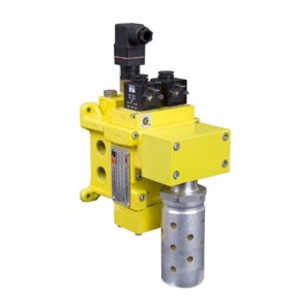
- A double safety valve with dynamic monitoring is a redundant safety device used in pneumatic systems to provide a high level of protection for personnel and equipment. It consists of two independent valve elements in series — both must be energized (open) to allow air to pass to the downstream equipment, and either one failing or de-energizing will stop air flow and exhaust the downstream pressure. The dynamic monitoring function continuously checks that both valve elements are operating correctly by verifying that they open and close in the proper sequence each time the valve cycles. If the monitor detects that one element is stuck open, stuck closed, or responding out of sequence, it locks the valve out and signals a fault — preventing the system from operating in an unsafe condition with only one layer of protection. These valves are essential in press safety, machine guarding, and other applications where pneumatic energy must be reliably controlled to prevent hazardous machine motion. Ross Controls DM1 Series double safety valves available through Centro include NPT and BSPP connections, DIN and M12 electrical connections, and optional status indicators for visual confirmation of valve state.
- Pneumatic safety valves are required in any application where uncontrolled release of compressed air energy could damage equipment or injure workers. Machine safety is the primary application — presses, stamping machines, robots, and automated assembly systems use double safety valves to ensure that pneumatic cylinders and actuators cannot move unexpectedly when workers are in the danger zone. These valves are a critical component of safety control systems designed to meet safety standards such as OSHA requirements, ISO 13849 (safety of machinery), and ANSI/NFPA 79. General pneumatic systems in manufacturing plants use pressure relief valves to protect air receivers, distribution piping, and downstream equipment from over-pressurization if regulators fail. Packaging equipment, material handling systems, and industrial automation systems all use pneumatic safety valves to ensure safe operation. Process plants use them to protect pneumatic instrumentation and control systems. Any facility that uses compressed air as a power source should have properly rated pneumatic safety valves installed and maintained as part of their overall safety program.
- A pneumatic pressure relief valve uses a spring-loaded poppet or disc that holds the valve closed against the system pressure during normal operation. The spring is calibrated to a specific set pressure — as long as the system pressure remains below this set point, the spring force exceeds the pressure force and the valve stays closed. When system pressure rises to the set point, the pressure force on the poppet overcomes the spring force and the valve opens, venting air to atmosphere (or to a safe exhaust location) to reduce the pressure. As the system pressure drops back below the set point, the spring pushes the poppet closed and the valve reseals. Pilot-operated pressure relief valves use a small pilot mechanism to sense the system pressure and a larger main valve to handle the relief flow — this design provides more precise set-point accuracy and higher relief capacity in a compact package. The Ross 2768 Series available through Centro is a dual pilot-operated pressure relief poppet check valve that provides both overpressure protection and check valve functionality in one unit, with an adjustable set pressure range of 15 to 150 PSIG.
- Selecting the right pneumatic safety valve requires matching several parameters to your specific system. First, determine the required set pressure — this is the pressure at which the valve must open to protect the system, and it should be set above the normal maximum operating pressure but below the weakest component's rated pressure. Second, determine the required relief capacity — the valve must be able to vent enough air flow to prevent pressure from continuing to rise even under the worst-case scenario (such as a failed-open regulator delivering full supply pressure). Third, select the connection size and type (NPT or BSPP) to match your piping. For machine safety applications requiring redundant protection, specify a double safety valve with dynamic monitoring rated for the appropriate safety performance level. Consider whether you need status indicators for visual confirmation of valve state, and choose the electrical connection type (DIN or M12) compatible with your safety control system. Always verify that the valve carries the appropriate safety certifications and ratings for your industry and application standards.