
Valve Accessories - Strahman
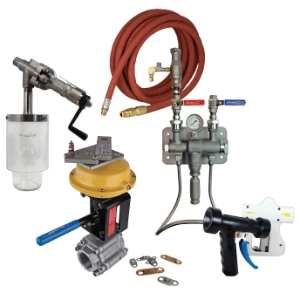
Valve accessories are additional components that enhance the functionality and performance of valves in fluid control systems. These accessories are designed to provide other features, improve safety, or simplify maintenance of the valves. Valve accessories enhance the reliability, efficiency, and safety of valve operations, making them essential for various industries such as oil and gas, chemical processing, water treatment, and power generation.
$163.93
Subject to factory lead times
$688.90
Subject to factory lead times
$853.87
Subject to factory lead times
$542.62
Subject to factory lead times
$603.83
Subject to factory lead times
$621.47
Subject to factory lead times
$803.03
Subject to factory lead times
$666.08
Subject to factory lead times
$867.35
Subject to factory lead times
$232.40
Subject to factory lead times
$249.00
Subject to factory lead times
$260.42
Subject to factory lead times
$163.93
Subject to factory lead times
$688.90
Subject to factory lead times
$853.87
Subject to factory lead times
$542.62
Subject to factory lead times
$603.83
Subject to factory lead times
$621.47
Subject to factory lead times
$803.03
Subject to factory lead times
$666.08
Subject to factory lead times
$867.35
Subject to factory lead times
$232.40
Subject to factory lead times
$249.00
Subject to factory lead times
$260.42
Subject to factory lead times
- Valve accessories are additional components that enhance the functionality, safety, monitoring, and integration of valves in fluid control and automation systems. While the valve itself provides the basic flow control function, accessories extend its capabilities to meet the demands of modern automated process and manufacturing systems. Common valve accessories include solenoid connectors and cable assemblies (that provide the electrical connection between the control system and the solenoid coil on pilot-operated and solenoid valves), limit switches and position indicators (that confirm whether the valve is open, closed, or at an intermediate position and report that status back to the control system), mounting brackets and adapters (that allow valves to be installed on actuators, manifolds, or piping), manual overrides (that allow operators to manually actuate a valve during testing, commissioning, or control system failures), and speed controllers, flow sensors, and other inline accessories. Centro carries a range of valve accessories from multiple manufacturers to support the valves in their product line.
- Solenoid valve connectors are the electrical plug-and-cable assemblies that connect the solenoid coil on a valve to the plant's control wiring. They matter because a reliable electrical connection is essential for the valve to operate when commanded — a failed, corroded, or water-damaged connector can prevent the valve from energizing, causing process upsets, safety issues, or production downtime. Industrial solenoid connectors are available in standardized form factors (DIN 43650 Form A, B, and C are the most common, as well as M12 circular connectors) with different electrical ratings, ingress protection levels, and features. Key selection criteria include the voltage and current rating (must match the solenoid coil), the ingress protection rating (IP65 or IP67 for outdoor and washdown environments to prevent water and dust from reaching the electrical contacts), whether the connector includes a built-in LED indicator (for visual confirmation that the valve is energized), whether it includes a built-in surge suppression circuit (to protect the control system from voltage spikes when the solenoid de-energizes), and the cable length and type needed for the installation.
- Valve limit switches and position indicators are devices mounted on a valve or actuator that detect and report the valve's position (open, closed, or intermediate) back to the plant control system. They serve several important functions: confirming that the valve has actually reached the commanded position (so the control system knows the valve responded to its signal), providing input for safety interlocks (for example, verifying that an isolation valve is fully closed before allowing maintenance personnel to enter a confined space), triggering sequential operations (opening a downstream valve only after confirming the upstream valve has closed), and providing visual indication to operators in the field (colored dome indicators that show red for closed and green for open at a glance). Mechanical limit switches use a physical contact that is actuated by the valve stem or actuator shaft rotation. Proximity switches (inductive or magnetic) detect the valve position without physical contact, providing longer service life in high-cycle applications. Visual indicators provide a colored dome or flag visible from a distance.
- A manual override is a mechanical device built into a solenoid valve that allows an operator to manually actuate the valve without an electrical signal to the solenoid coil. It typically consists of a push button, push pin, or small lever accessible on the outside of the valve body. When pressed or turned, it mechanically shifts the valve's internal element to the actuated position, just as the solenoid would. Manual overrides are needed in several situations: during commissioning and testing when the control system may not yet be connected or programmed, the manual override allows technicians to verify that the valve and connected equipment function correctly. During control system failures or power outages, operators can manually operate critical valves to maintain safe plant conditions or perform an orderly shutdown. During troubleshooting, the manual override allows maintenance personnel to determine whether a valve problem is electrical (solenoid or wiring) or mechanical (stuck valve element) by testing the valve independently of its electrical circuit.
- A complete automated valve package typically includes the valve body, actuator, and several accessories that provide control, feedback, and safety functions. A solenoid pilot valve (if not integral to the actuator) provides the control air signal to operate the pneumatic actuator based on electrical commands from the control system. A valve positioner (for modulating/throttling applications) precisely positions the valve based on a 4-20 mA control signal. Limit switches or position indicators confirm the valve position and report it to the control system for interlock and sequence logic. A solenoid connector with appropriate IP rating, LED indicator, and surge suppression provides the electrical connection. Mounting brackets and hardware connect the accessories to the actuator. An air filter-regulator ensures clean, properly pressurized instrument air supply to the actuator and accessories. A manual override provides backup manual operation capability. Tubing and fittings connect the air supply, pilot valve, and actuator. The specific accessories needed depend on the application — simple on/off isolation may only need a pilot valve and limit switches, while modulating control requires a positioner and potentially a transducer as well.