
Shock Absorbers
Industrial Shock Absorbers are designed to protect your equipment from the harmful effects of shock and vibration. Shock absorbers are essential to many industrial applications, including packaging, material handli...
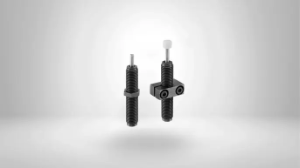
Dampeners, often referred to as dampers, are vital mechanical components employed in various engineering and industrial systems to control airflow, vibration, noise, and other dynamic factors. These devices are designed to mitigate the effects of sudden changes in flow, pressure, or force within a system. Common examples include HVAC dampers used to regulate airflow in heating and cooling systems, vibration dampeners in machinery to reduce vibrations and noise, and shock absorbers in automotive suspensions to provide a smoother ride. Dampeners function by dissipating or redirecting energy, helping maintain stability, reduce noise pollution, and enhance overall system performance. Their versatile applications across numerous industries make dampeners crucial for optimizing safety, comfort, and efficiency in various mechanical systems.

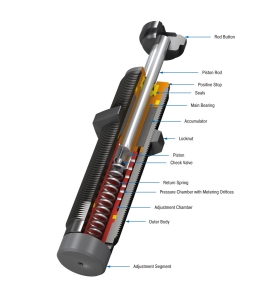
Industrial shock absorbers are precision devices designed to absorb kinetic energy and control deceleration in high-speed machinery, enhancing safety, extending equipment life, and reducing noise and vibration. Commonly used in automation, robotics, and heavy equipment, these components protect systems from impact damage during motion stops or collisions. With adjustable and self-compensating models available, industrial shock absorbers ensure smooth, repeatable performance in dynamic and high-cycle operations.
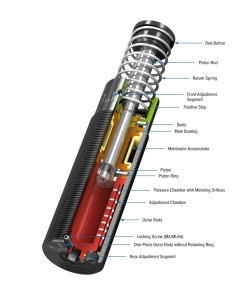
Miniature shock absorbers are compact energy-absorbing devices engineered to manage impact and deceleration in small-scale, high-speed automation and precision equipment. Ideal for robotics, medical devices, electronics assembly, and compact machinery, these shock absorbers provide smooth, controlled motion while minimizing wear, vibration, and noise. Despite their small size, they deliver reliable performance and protection in tight spaces where precision and durability are critical.
$72.32
$80.80
$80.80
$69.10
Subject to factory lead times
$184.46
$196.91
$70.84
$70.84
$257.34
Subject to factory lead times
$257.34
Subject to factory lead times
$269.63
$269.63
$72.32
$80.80
$80.80
$69.10
Subject to factory lead times
$184.46
$196.91
$70.84
$70.84
$257.34
Subject to factory lead times
$257.34
Subject to factory lead times
$269.63
$269.63
- Industrial shock absorbers are hydraulic devices that absorb kinetic energy and decelerate moving loads in a controlled manner — converting motion energy into heat through oil displacement. They are used in automation, packaging, material handling, machine tooling, and any application where a moving mass must be brought to a smooth, controlled stop. Common applications include decelerating pneumatic cylinders at end-of-stroke, cushioning conveyor transfers and pallet stops, protecting crane and gantry end stops, and absorbing impact in robotic pick-and-place operations. Without shock absorbers, moving equipment experiences hard impacts that generate noise, vibration, and mechanical stress — leading to premature wear, loosened fasteners, and damaged components.
- Self-compensating (also called self-adjusting or fixed) shock absorbers automatically adapt their damping characteristics across their full range of rated effective weights without any manual adjustment. They are the simplest to specify and install — select the model based on the energy and effective weight range, install it, and it works. Adjustable shock absorbers allow the user to manually tune the damping rate by turning an adjustment knob, optimizing performance for a specific load and speed. Adjustable models offer more flexibility when the application conditions vary or when fine-tuning is needed to achieve the ideal deceleration profile. For most standard automation applications with consistent loads, self-compensating models are the preferred choice for their simplicity and reliability. Adjustable models are better suited for applications where conditions change or where precise control of the deceleration curve is required.
- Gas springs use compressed nitrogen gas inside a sealed cylinder to provide a controlled pushing or supporting force — they extend under their own internal pressure and resist compression. They are used to assist in lifting, lowering, holding, and counterbalancing heavy lids, doors, covers, hoods, and machine guards. Shock absorbers, by contrast, absorb kinetic energy and decelerate moving objects — they resist motion in one direction and do not provide a pushing force of their own. In simple terms, a gas spring pushes or holds a load, while a shock absorber stops a load. The two are often used in complementary roles within the same machine: a gas spring assists in raising a heavy cover, and a shock absorber decelerates equipment that reaches the end of its travel.
- Sizing a shock absorber requires four key parameters: the effective weight (mass of the moving object plus any driven mass), the impact velocity at contact, the number of cycles per hour, and the stroke length available. From these values, you calculate the kinetic energy per cycle (½ × mass × velocity²) and the total energy per hour. The shock absorber must have an energy-per-cycle capacity and an energy-per-hour (thermal) capacity that both exceed the calculated values. Additionally, the effective weight of the load must fall within the shock absorber's rated effective weight range. Most manufacturers provide online sizing calculators where you input these parameters and receive a recommended model. Undersizing causes bottoming out and mechanical damage; oversizing results in unnecessarily high reaction forces and cost. When in doubt, contact a product expert with your application data for a proper sizing recommendation.
- Safety shock absorbers are heavy-duty units designed for emergency stop and safety applications where the consequence of failure is equipment damage or personnel injury. Unlike standard automation shock absorbers designed for continuous high-cycle operation, safety shock absorbers are engineered to reliably absorb very high energy in infrequent, critical events — such as stopping a crane at end-of-travel, arresting a runaway carriage, or providing emergency deceleration on a transfer car. They feature robust construction, oversized piston rods, internal system seals that prevent leakage even if the rod is scratched or dirty, and compressed gas accumulators that provide high return forces. Safety shock absorbers are typically custom-calculated for each specific application to ensure the damping characteristics match the exact load, velocity, and safety requirements.