
Enclosures
At Centro, we carry a complete selection of enclosures available to purchase online. Electrical enclosures protect electrical components from the environment and prevent accidental contact with live wires. Disconne...
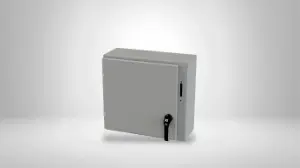
Standard electrical enclosures are essential components used to house and protect electrical equipment, controls, and wiring. These enclosures provide a safe and secure environment, shielding sensitive electrical components from environmental factors, such as dust, moisture, and physical damage. Standard electrical enclosures are typically made of durable materials, such as steel or aluminum, and feature a sturdy construction with proper sealing to ensure reliable protection. They come in various sizes, configurations, and mounting options to accommodate different equipment and installation requirements. Standard electrical enclosures are crucial in maintaining the integrity and longevity of electrical systems, ensuring safety and efficient operation in industrial, commercial, and residential applications.

$77.10
Subject to factory lead times

$77.19$98.98
Subject to factory lead times

$284.75$365.15
Subject to factory lead times

$291.86$374.28
Subject to factory lead times

$298.99$383.42
Subject to factory lead times

$306.11$392.55
Subject to factory lead times

$581.51$745.71
Subject to factory lead times

$785.02$1,006.70
Subject to factory lead times

$785.02$1,006.70
Subject to factory lead times

$90.05$115.47
Subject to factory lead times

$93.06$119.34
Subject to factory lead times

$96.06$123.18
Subject to factory lead times
$77.10
Subject to factory lead times
$77.19$98.98
Subject to factory lead times
$284.75$365.15
Subject to factory lead times
$291.86$374.28
Subject to factory lead times
$298.99$383.42
Subject to factory lead times
$306.11$392.55
Subject to factory lead times
$581.51$745.71
Subject to factory lead times
$785.02$1,006.70
Subject to factory lead times
$785.02$1,006.70
Subject to factory lead times
$90.05$115.47
Subject to factory lead times
$93.06$119.34
Subject to factory lead times
$96.06$123.18
Subject to factory lead times
- An electrical enclosure houses and protects electrical components — terminals, PLCs, relays, drives, and wiring — from the surrounding environment and prevents accidental contact with live conductors. In industrial settings they also organize and centralize controls, making systems easier to maintain, troubleshoot, and modify. The enclosure is the first line of defense between sensitive electronics and dust, moisture, chemicals, vibration, and physical impact.
- NEMA ratings define what an enclosure protects against. NEMA 1 covers basic indoor use — finger protection and dust only. NEMA 4 handles indoor and outdoor use including hose-directed water and splashing. NEMA 4X adds corrosion resistance for washdown, chemical, and coastal environments. NEMA 7 is required in Class I hazardous locations where flammable gases may be present. NEMA 12 is the standard choice for general industrial indoor use with protection against dust, dirt, and dripping liquids. When in doubt, select one rating above the minimum your environment requires.
- Aluminum enclosures are lighter, naturally corrosion-resistant, and easier to modify in the field — ideal for outdoor installations, control pendants, and applications where weight matters. Steel enclosures offer greater rigidity and impact resistance and are the standard choice for fixed panel installations in mechanical rooms and on machine frames. Stainless steel is specified for washdown, food processing, and highly corrosive chemical environments where neither painted steel nor aluminum provides adequate protection.
- Start by laying out all components — DIN rail, terminals, drives, power supplies — and calculating their footprint. Add 20–30% spare space for future additions, wiring runs, and heat dissipation. Depth must accommodate the deepest component plus clearance for door-mounted devices and cable routing. Thermal management is a sizing factor too — a densely packed enclosure with heat-generating drives may require a larger cabinet or supplemental cooling to stay within component temperature ratings.
- No. Standard NEMA 1, 4, or 12 enclosures are not rated for hazardous classified locations. Areas where flammable gases, vapors, or combustible dusts may be present require enclosures specifically rated for that classification — NEMA 7 for Class I gas/vapor hazards, NEMA 9 for Class II dust hazards, or enclosures carrying the appropriate ATEX or IECEx certification for international installations. Using a non-rated enclosure in a classified location is a serious safety and code compliance violation.
- Single-door enclosures suit compact panel builds where all components are accessible from one face. Multi-door or double-door configurations are used for larger panels where the door width would be unmanageable as a single piece, or where separate access zones are needed — for example, isolating high-voltage sections from low-voltage control wiring. Some large enclosures also include rear-access doors for wiring entry or back-panel maintenance without opening the main front door.