
PFA Lined Plug Valves
PFA (perfluoroalkoxy) lined plug valves are indispensable assets in fluid handling systems, renowned for their exceptional chemical resistance and reliability. These valves feature a PFA lining that shields against corrosion and withstands aggressive chemicals, acids, and bases, ensuring longevity and efficiency in diverse industrial environments. With a plug design that rotates within the valve body, PFA-lined plug valves offer precise flow control and secure shut-off, even in demanding applications. Their robust construction and resistance to abrasion make them suitable for handling abrasive slurries, viscous fluids, and corrosive media. PFA-lined plug valves find extensive use in industries such as chemical processing, pharmaceuticals, and water treatment, where stringent quality standards and reliability are paramount. With their ability to deliver dependable performance and maintain product integrity, PFA-lined plug valves are trusted components for critical fluid handling processes.
$420.96$539.00
Subject to factory lead times
$420.96$539.00
Subject to factory lead times
$1,504.22$1,926.00
Subject to factory lead times
$771.64$988.00
$962.98$1,233.00
$1,078.57$1,381.00
$7,262.59$9,299.00
Subject to factory lead times
$586.54$751.00
$3,380.98$4,329.00
Subject to factory lead times
$420.96$539.00
Subject to factory lead times
$420.96$539.00
Subject to factory lead times
$1,504.22$1,926.00
Subject to factory lead times
$771.64$988.00
$962.98$1,233.00
$1,078.57$1,381.00
$7,262.59$9,299.00
Subject to factory lead times
$586.54$751.00
$3,380.98$4,329.00
Subject to factory lead times
- A PFA lined plug valve is a quarter-turn valve in which the body and plug are fully lined with PFA (perfluoroalkoxy), a high-performance fluoropolymer that provides exceptional chemical resistance against virtually all corrosive media. The PFA lining creates a complete barrier between the process fluid and the valve's structural metal components (typically ductile iron), protecting them from corrosion by aggressive chemicals that would destroy unlined metal valves. PFA lined plug valves are used in chemical processing plants for handling concentrated acids (hydrochloric, sulfuric, hydrofluoric, nitric), strong caustics, chlorine and hypochlorite, organic solvents, and other highly corrosive fluids. They are also used in pharmaceutical manufacturing, water and wastewater treatment (for corrosive treatment chemicals), and any application where both chemical resistance and reliable shutoff are critical. Centro carries the Durco T4E Lined Plug Valve with PFA-lined ductile iron body and plug, ANSI Class 150 flanged, with standard wrench or gear operator options.
- Both PFA lined plug valves and PFA lined butterfly valves provide corrosion-resistant flow control for aggressive chemical services, but they differ in sealing performance, flow characteristics, and application suitability. PFA lined plug valves provide tighter shutoff because the plug-to-body sealing interface wraps around the full circumference of the cylindrical plug, creating a larger, more uniform sealing surface area. This makes them the preferred choice when drop-tight, bubble-tight shutoff is an absolute requirement — particularly for hazardous or expensive chemicals where even minor leakage is unacceptable. PFA lined butterfly valves use a disc-to-seat sealing arrangement that provides good shutoff for most applications but may not achieve the same level of zero-leakage performance in all conditions. Butterfly valves offer lower pressure drop and higher flow capacity for a given pipe size due to their full-bore disc design, making them better suited for larger line sizes and applications where flow efficiency is a priority. The choice between them depends on whether shutoff tightness or flow capacity is the primary concern for your specific application.
- PFA is one of the most chemically resistant materials available for valve lining, making PFA lined plug valves suitable for handling virtually all industrial chemicals. This includes strong mineral acids (hydrochloric acid, sulfuric acid, nitric acid, hydrofluoric acid, and phosphoric acid at all concentrations), strong bases and caustics (sodium hydroxide, potassium hydroxide), halogens and halogen compounds (chlorine, bromine, sodium hypochlorite, chlorine dioxide), organic solvents (acetone, toluene, methanol, and most other common solvents), and oxidizing agents. PFA is also resistant to deionized and ultrapure water, which is important in pharmaceutical and semiconductor applications where metal ion contamination from the valve must be eliminated. The few chemicals that can attack PFA include molten alkali metals, elemental fluorine at high temperatures, and certain fluorinated compounds under extreme conditions — but these are rarely encountered in typical industrial valve applications. The PFA lining handles continuous service temperatures up to approximately 400°F (204°C) while maintaining full chemical resistance and mechanical integrity.
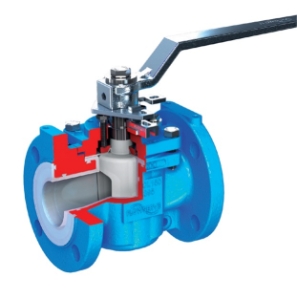
- A PFA lined plug valve has a ductile iron structural body and plug that provide mechanical strength and pressure containment, with all wetted surfaces (the interior of the body, the flange faces, the plug exterior, and the stem sealing area) fully lined or encapsulated with a thick, continuous layer of PFA. The ductile iron body is typically cast to ASTM A395 and provides the structural integrity to handle the piping loads and operating pressures up to ANSI Class 150 ratings. The PFA lining is molded or applied to cover every surface that comes in contact with the process media, creating a seamless fluoropolymer barrier with no exposed metal. The plug is a ductile iron or stainless steel core fully encapsulated in PFA, rotating within the PFA-lined body cavity. The top cap (bonnet) is also ductile iron and contains the stem sealing arrangement. The flanged end connections are PFA-lined on the face to prevent corrosion at the gasket interface. This construction gives the valve the pressure and structural capability of a metal valve with the chemical resistance of a fluoropolymer-lined system.
- Maintaining a PFA lined plug valve primarily involves protecting the PFA lining from mechanical damage and operating within the rated conditions. Always follow the manufacturer's recommended flange bolt torque values during installation — overtightening can crack or deform the PFA lining on the flange face, creating a pathway for corrosive media to reach and attack the ductile iron body underneath. Use proper gaskets rated for the chemical service (typically PTFE envelope gaskets or solid PTFE gaskets for corrosive applications). Cycle the valve periodically in on/off applications where it may sit in one position for extended periods — this prevents the plug from seizing due to chemical deposits or temperature-related expansion of the lining. Monitor the valve for any increase in operating torque, which can indicate buildup or swelling of the lining. Inspect the PFA lining periodically for signs of permeation (chemical migrating through the lining to the metal substrate), swelling, blistering, or cracking — especially in high-temperature or highly concentrated chemical services near the lining's rated limits. If the lining is damaged, the valve should be relined by the manufacturer or replaced, as field repairs to a fluoropolymer lining are not reliable for maintaining corrosion protection.