
Instrumentation, Measurement and Control - Trerice
Instrumentation refers to devices that measure or control physical variables such as temperature, level, flow, or pressure. These products are essential in the industry because they allow for maximum output with mi...

Temperature regulators control temperature without external power. A thermal sensor directly moves a valve to hold set point in steam, water and heat transfer systems.
Applications
- Water heaters and heat exchangers – steady outlet temperature
- Process tanks – heating control
- Cooling water – engine and compressor cooling
- HVAC systems – simple temperature control
Choosing a Regulator
Select by temperature range, valve size, flow and media (steam, water or oil). Capillary length must reach from sensor to valve. Self-acting regulators are dependable where power isn't available.
Centro supplies temperature regulators for steam and water systems.
Related categories: Temperature Measurement, Instrumentation and Control | Temperature Sensors | Thermowells | Temperature Transmitters | Temperature Recording

Industrial pressure gauges are built for the vibration, pulsation and rough handling found in plants, pump rooms and machinery. They give operators a dependable local reading of pressure in water, air, oil, steam and process lines.
Industrial Gauge Options
- Stainless steel cases – corrosion resistance and durability
- Liquid-filled gauges – dampen vibration and pulsation for steady readings
- Brass and stainless internals – match media compatibility
- Bottom and back connections – for line and panel mounting
- Dial sizes from 2" to 6" – readable at a distance
Selecting a Gauge
Choose a range so normal operating pressure sits in the middle of the dial, generally about twice the operating pressure. Use a liquid-filled gauge on pumps and compressors, and add a snubber for pressure spikes. Confirm the connection size and accuracy grade.
Centro carries industrial pressure gauges for plant, process and equipment applications.
Related categories: Pressure Gauges | Process Gauges | Commercial Gauges | Test Gauges | Differential Pressure Gauges

Commercial pressure gauges cover HVAC, plumbing, fire protection and general building services. They're economical, easy to read and available in many standard ranges.
Commercial Gauge Options
- Dry and liquid-filled gauges – general service
- Brass internals – water, air and oil
- Common dial sizes – 2" to 4"
- Bottom and back connections – line or panel mounting
- Fire protection gauges – sprinkler system ratings
Choosing a Gauge
Select a range about twice normal operating pressure, and match connection size and dial type. Liquid-filled gauges handle vibration from pumps.
Centro supplies commercial gauges for HVAC, plumbing and building systems.
Related categories: Pressure Gauges | Test Gauges | Process Gauges | Differential Pressure Gauges | Industrial Gauges

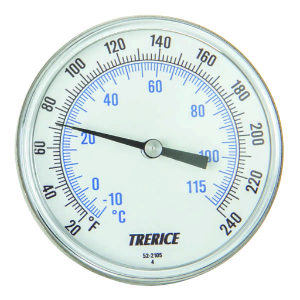
Bimetal thermometers are widely used temperature measurement devices that employ a bimetallic strip to indicate temperature changes. These thermometers consist of two metal strips, typically made of different metals with different coefficients of thermal expansion, bonded together. The metals expand or contract at different rates as the temperature changes, causing the bimetallic strip to bend. This bending motion is then translated into a rotational movement displayed on a calibrated dial to indicate the temperature. Bimetal thermometers are known for their simplicity, durability, and cost-effectiveness. They are commonly used in various industries and applications requiring reliable temperature monitoring, such as HVAC systems, automotive, food processing, and industrial processes. Bimetal thermometers offer advantages such as wide temperature ranges, resistance to shock and vibration, and ease of installation. They are available in different sizes and configurations to suit specific application requirements. With their robust construction and accurate temperature indication, bimetal thermometers provide a reliable and cost-effective temperature measurement solution in various industrial and commercial settings.
Related categories: Thermometers | Industrial Thermometers

Process pressure gauges are built for chemical, petrochemical, refining and power plant service. Heavy-duty cases, stainless wetted parts and high accuracy give dependable readings in demanding environments.
Process Gauge Features
- Solid-front safety cases – operator protection
- 316 stainless steel internals – corrosive media
- Liquid filling – vibration and pulsation damping
- Accuracy to 0.5% – precise readings
- 4.5" and 6" dials – easy reading
Choosing a Process Gauge
Choose range, accuracy, connection and materials suited to the process. Add diaphragm seals for corrosive, viscous or high-temperature media.
Centro supplies process gauges and accessories for plant instrumentation.
Related categories: Pressure Gauges | Commercial Gauges | Industrial Gauges | Test Gauges | Differential Pressure Gauges

Thermowells protect temperature sensors from pressure, flow, corrosion and abrasion. They also let you remove sensors for replacement or calibration without draining or shutting down the process.
Thermowell Types
- Threaded thermowells – common for general service
- Socket weld and weld-in – high-pressure installations
- Flanged thermowells – easy removal and corrosive service
- Sanitary thermowells – tri-clamp for food and pharma
- Tapered and stepped stems – strength and fast response
Choosing a Thermowell
Select material, insertion length, bore size and connection. For high-velocity flows, perform a wake frequency calculation to avoid stem failure.
Centro supplies thermowells for temperature sensors and thermometers.
Related categories: Temperature Measurement, Instrumentation and Control | Temperature Regulators | Temperature Transmitters | Temperature Sensors | Temperature Recording

Industrial thermometers are specialized devices used to measure temperature in various industrial applications. These thermometers are designed to withstand harsh environmental conditions and provide accurate temperature readings in industrial settings. They are constructed with durable materials, such as stainless steel or ruggedized plastic, to withstand high temperatures, pressure, and vibrations. Industrial thermometers come in various types, including bimetallic thermometers, gas-actuated thermometers, infrared thermometers, and digital thermometers. They are used in industries such as manufacturing, oil and gas, HVAC, and food processing, where precise temperature control is critical for operational efficiency and safety. Industrial thermometers offer features such as wide temperature ranges, high accuracy, and corrosion resistance. They are often equipped with protective features like IP ratings or explosion-proof enclosures to ensure safe and reliable operation in hazardous environments. With their ability to provide reliable temperature measurements, industrial thermometers are crucial in process control, quality assurance, and monitoring critical temperature parameters in various industrial applications.
Related categories: Thermometers | Bi-Metal Thermometers

Pressure snubbers smooth out pressure spikes and pulsations before they reach gauges, switches and transmitters. Damping the surges gives steadier readings and helps instruments last longer, especially near pumps, compressors and quick-closing valves.
Snubber Types
- Porous metal disc snubbers – sintered elements for gases and light liquids
- Piston snubbers – self-cleaning action for dirtier fluids
- Adjustable snubbers – tune the damping to your system
- Brass and stainless steel – match media compatibility
Choosing a Snubber
Select the element grade based on fluid viscosity: finer discs for air and water, coarser for oils. Match thread sizes to your gauge and process connection. For very severe pulsation, combine a snubber with a liquid-filled gauge.
Centro carries pressure snubbers and gauge accessories to protect your instruments.
Related categories: Pressure Control Accessories | Manifold Valves | Gauge Cock Valve | Instrument Valve | Syphons

Needle valves give fine, repeatable control of low flows in instrument lines, sampling systems and gauge isolation. A slender, tapered stem seats into a matching orifice, so a few turns of the handle let you dial in precise flow or shut it off completely.
Needle Valve Options
- Straight and angle patterns – suit your piping layout
- Hard-seat and soft-seat designs – metal seats for high temperature, PTFE or PEEK for bubble-tight shutoff
- Bar stock and forged bodies – in 316 stainless steel, brass and carbon steel
- NPT, tube and socket weld ends – connect directly to tubing or pipe
- High-pressure models – rated to 6,000 psi and beyond
Selecting a Needle Valve
Consider the pressure and temperature rating, the flow coefficient (Cv) you need, and the media's compatibility with the body and packing. Choose regulating stems for throttling and standard stems for isolation. Panel-mount options and lockable handles are available for instrument panels.
Centro carries instrumentation needle valves in a wide range of sizes and materials for process, hydraulic and analytical systems.

Gauge cock valves isolate pressure gauges, switches and transmitters from the process so they can be removed, replaced or calibrated without shutting down the line. They're a small, inexpensive part that saves a lot of time.
Gauge Cock Options
- Tee handle and lever handle – quick quarter-turn operation
- Brass, carbon steel and stainless – match media and environment
- Male and female NPT connections – fit common gauge installations
- Bleed and vent options – safely relieve trapped pressure
- Needle-style gauge valves – higher pressure service
Choosing a Valve
Select the material, pressure rating and connection size for your gauge and process. On steam, use a syphon between the gauge cock and gauge. Bleed valves make gauge removal safer.
Centro carries gauge cock valves and pressure accessories for instrument installations.
Related categories: Pressure Control Accessories | Instrument Valve | Manifold Valves | Syphons | Pressure Snubber

A syphon is a simple yet effective tube-shaped device that consists of two legs bent in a U-shape. The purpose of the syphon is to transfer liquid from a higher container or location to a lower one without the need for any external pumping or suction. One leg of the syphon is inserted into the higher container or source of liquid, while the other leg is placed into the lower container. The liquid in the higher container initially fills the syphon's legs, creating a continuous flow due to the difference in pressure between the two ends. Gravity then causes the liquid to flow through the syphon, moving from the higher to the lower container. Syphons are commonly used in various applications, including laboratory experiments, aquariums, irrigation systems, and fluid transfers in industrial processes. They provide a simple and efficient means of transferring liquids over a vertical or horizontal distance without the need for complex pumps or mechanical devices.
Related categories: Pressure Control Accessories | Instrument Valve Accessories | Instrument Valve | PT Plugs | Gauge Cock Valve
We offer pressure gauges, vital instruments that measure and indicate fluid or gas pressure within a system. These gauges are commonly employed in various industries, including manufacturing, oil and gas, automotive, and HVAC systems. Pressure gauges consist of a dial or digital display that shows the pressure reading and a sensing element that detects the pressure and converts it into a readable form. They come in different types, such as Bourdon tube gauges, diaphragm gauges, and digital pressure gauges, each suited for specific applications and pressure ranges. Pressure gauges provide crucial information for monitoring and controlling processes, ensuring optimal performance and safety. They enable operators to gauge system pressure levels, detect abnormalities, and make informed decisions regarding system adjustments or maintenance. Pressure gauges may also incorporate features such as maximum pressure indicators, adjustable pointers, or alarms for added functionality. With their accuracy, reliability, and ease of use, pressure gauges are crucial in maintaining operational efficiency and safety in various industries.
Shop by type: Boiler Gauges | Manometers | Pressure Gauges | Gauge Parts & Accessories | Tridicators
Related categories: Pressure Control | Pressure Switch | Pressure Control Accessories | Pressure Transmitters | Pressure Transducers
Pressure control products measure, monitor and regulate pressure in liquids, gases and steam. Accurate pressure control protects equipment and keeps processes stable.
Pressure Control Products
- Gauges – pressure, differential and specialty gauges
- Pressure transmitters and transducers – electronic monitoring
- Pressure switches – alarm and control set points
- Pressure regulators and sequence valves – control downstream pressure
- Accessories – snubbers, syphons, manifolds and gauge valves
Building a Measurement Point
Choose instrument range, accuracy and wetted materials, then add the right accessories, such as isolation valves and snubbers, for safe, accurate readings.
Centro supplies pressure control instruments and accessories from leading brands.
Shop by type: Pressure Transducers | Pressure Control Accessories | Gauges | Pressure Switch | Pressure Transmitters | Pressure Regulators | Sequence Valves
Related categories: Instrumentation, Measurement and Control | Controllers | Flow Control | Recorders | Seals and Accessories

Temperature accessories help your sensors and instruments read accurately and last longer. Thermowells, fittings, connection heads and extension wire protect sensors from the process and make installation and replacement simpler.
Accessories Available
- Thermowells – threaded, socket weld and flanged wells protect sensors from pressure and flow
- Compression fittings – adjustable sensor insertion depth
- Connection heads – house terminal blocks and head-mount transmitters
- Thermocouple and RTD extension wire – carry signals back to the controller
- Connectors and plugs – quick disconnects for sensors
Choosing Accessories
Select thermowell material and length for the process, with the tip in the flow, and check the wake frequency calculation for high-velocity lines. Use extension wire that matches the thermocouple type to avoid reading errors. Head and enclosure ratings should match the environment.
Centro carries temperature accessories to complete your sensor installations.
Related categories: Temperature Measurement, Instrumentation and Control | Thermometers | Heat Exchangers | Thermocouples and RTDs | Temperature Switches

$37.88$65.75
$37.88$65.75
Subject to factory lead times

$37.88$65.75
$37.88$65.75
Subject to factory lead times

$37.88$65.75
$37.88$65.75
Subject to factory lead times

$37.88$65.75
Subject to factory lead times
$37.88$65.75
Subject to factory lead times
$37.88$65.75
Subject to factory lead times
$37.88$65.75
Subject to factory lead times

$37.88$65.75
Subject to factory lead times
$37.88$65.75
Subject to factory lead times
$37.88$65.75
Subject to factory lead times
$37.88$65.75
Subject to factory lead times

$37.88$65.75
$37.88$65.75
Subject to factory lead times
$37.88$65.75
Subject to factory lead times
$37.88$65.75
Subject to factory lead times
$37.88$65.75
Subject to factory lead times
$37.88$65.75
Subject to factory lead times

$37.88$65.75
$37.88$65.75
Subject to factory lead times
$37.88$65.75
Subject to factory lead times
$37.88$65.75
Subject to factory lead times
$37.88$65.75
$37.88$65.75
Subject to factory lead times
$37.88$65.75
$37.88$65.75
Subject to factory lead times
$37.88$65.75
$37.88$65.75
Subject to factory lead times
$37.88$65.75
Subject to factory lead times
$37.88$65.75
Subject to factory lead times
$37.88$65.75
Subject to factory lead times
$37.88$65.75
Subject to factory lead times
$37.88$65.75
Subject to factory lead times
$37.88$65.75
Subject to factory lead times
$37.88$65.75
Subject to factory lead times
$37.88$65.75
Subject to factory lead times
$37.88$65.75
$37.88$65.75
Subject to factory lead times
$37.88$65.75
Subject to factory lead times
$37.88$65.75
Subject to factory lead times
$37.88$65.75
Subject to factory lead times
$37.88$65.75
Subject to factory lead times
$37.88$65.75
$37.88$65.75
Subject to factory lead times
$37.88$65.75
Subject to factory lead times
$37.88$65.75
Subject to factory lead times
- Selecting the right process instrument starts with defining four things: what variable you need to measure (temperature, pressure, flow, or level), the process conditions the instrument will face (media type, temperature range, pressure range, corrosiveness, and whether the environment is hazardous), the accuracy and response time your application requires, and how the measurement data needs to be communicated (local display only, 4–20 mA signal to a PLC/DCS, or digital protocol like HART or Modbus). For temperature, the choice between thermocouples, RTDs, and infrared sensors depends on the temperature range and accuracy needed. For pressure, gauge type, range, wetted materials, and whether you need local indication or a remote transmitter signal are the key decisions. For flow, the fluid properties (conductive liquid, gas, steam, slurry) determine whether a magnetic, ultrasonic, Coriolis, vortex, or variable-area meter is the best fit. For level, vessel conditions (open vs. pressurized, clean liquid vs. foam/solids) guide the choice between float switches, ultrasonic, radar, or differential pressure technologies. Centro's instrumentation specialists can help you match the right technology to your specific process conditions and budget.
- Accurate process instrumentation is the foundation of safe, efficient, and compliant operations. Every control loop — whether it manages boiler pressure, reactor temperature, tank level, or pipeline flow — depends on instruments that provide reliable, real-time measurements. If a temperature sensor reads inaccurately, a heater may overshoot and damage the product or create a safety hazard. If a level transmitter drifts, a tank may overflow or run dry. If a flow meter is undersized, the control system cannot maintain the correct feed rate. Beyond safety and quality, accurate instrumentation directly impacts energy consumption, raw material usage, and regulatory compliance. Calibrated, properly specified instruments reduce waste, prevent unplanned shutdowns, and provide the data required for regulatory reporting and quality documentation.
- A process control loop is a system that continuously measures a process variable, compares it to a desired setpoint, and adjusts an output to keep the variable at the setpoint. The loop consists of three elements: the sensor/transmitter (measures the variable — e.g., a thermocouple measuring temperature), the controller (compares the measurement to the setpoint and calculates a corrective output — typically a PID controller), and the final control element (adjusts the process — e.g., a control valve that opens or closes to change steam flow). Instruments are the eyes and ears of the loop — without accurate, responsive sensors and transmitters, the controller cannot make correct decisions, and the process drifts out of specification. The entire loop must be properly engineered as a system — sensor accuracy, transmitter range, controller tuning, and valve sizing must all be matched to the process requirements.
- Industrial instruments communicate with controllers and PLCs using standardized electrical signals. The 4–20 mA analog current loop is the most widely used signal in process instrumentation — it transmits a variable measurement as a proportional current (4 mA = zero/low range, 20 mA = full scale), and the current-based signal is resistant to voltage drop and electrical noise over long cable runs. The 0–10 V DC voltage signal is used in some HVAC and building automation applications but is more susceptible to noise and cable length limitations. Discrete (on/off) signals — from switches, relays, and transmitter alarm contacts — indicate threshold conditions like high level, low pressure, or flow/no-flow. Digital communication protocols — HART (layered on top of 4–20 mA for configuration and diagnostics), Foundation Fieldbus, PROFIBUS PA, and IO-Link — enable bidirectional communication between the instrument and the control system for advanced diagnostics, remote configuration, and multi-variable data.
- When instruments are installed in locations classified as hazardous (areas where flammable gases, vapors, or combustible dusts may be present), they must be approved for that classification to prevent ignition. Key considerations include the area classification (Class I for gases/vapors, Class II for dusts, with Division 1 for normally present hazards and Division 2 for abnormal conditions — or Zone 0/1/2 under ATEX/IECEx), the protection method (intrinsic safety, explosion-proof, non-incendive, or purged/pressurized), and the specific gas group and temperature class. Intrinsically safe (IS) instruments — used with IS barriers in the safe area — limit energy to levels too low to cause ignition and are the most common and practical approach for low-power sensors and transmitters. Explosion-proof enclosures contain any internal explosion and are used for higher-power devices. Always verify the instrument's certification (FM, CSA, ATEX, IECEx) matches the area classification before installation.