

Innovative Air Technologies
Custom Desiccant Dehumidifiers
Innovative Air Technologies dehumidifiers find widespread application across various industries globally. Our valued customers engage in diverse and fascinating endeavors, including food processing, pharmaceuticals, aerospace exploration, ice rinks, chemical processing, water treatment plants, test rooms, libraries, museums, and many more. At Innovative Air Technologies, we take immense pride in upholding our sterling reputation in these industries, achieved through unwavering commitment to complete customer satisfaction. This commitment is reflected in our on-time deliveries, provision of defect-free materials, and the delivery of impeccable service.
IAT employs cutting-edge desiccant dehumidification technology to regulate humidity levels within a space, employing a process known as adsorption. In this intricate process, moist air is drawn into the dehumidifier and routed over a desiccant wheel infused with silica gel. Within this wheel, excess humidity is effectively adsorbed into the silica material. IAT's dehumidifiers serve a multitude of purposes, including corrosion prevention, condensation control, mold and fungus mitigation, and moisture reduction. Moreover, they excel in tasks like product drying and dry cooling.
For further insights into the capabilities and applications of IAT's dehumidification solutions, contact Centro's knowledgeable product experts. We are here to assist you in optimizing your humidity control needs.
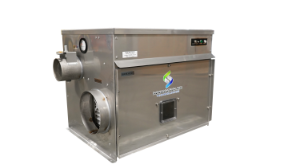
- A desiccant dehumidifier is an industrial air-drying system that removes moisture by pulling air across a rotating desiccant wheel or media bed. The desiccant material adsorbs water vapor from the airstream, delivering very low humidity levels that traditional refrigerant dehumidifiers cannot achieve. Most people are familiar with silica gel packets found in shoes and electronics, those are simple, single-use desiccant products. Industrial desiccant dehumidifiers, however, are continuous-duty systems. As moisture is captured on one section of the wheel, another section is regenerated with heat, allowing the unit to provide a constant supply of dry air. Although these systems require more energy to operate, they are essential for industries that depend on precise humidity control, such as food processing, pharmaceuticals, battery manufacturing, aerospace, cold-storage facilities, and any environment where condensation, mold, or product degradation is a concern.
- A desiccant dehumidifier uses a moisture-absorbing desiccant wheel to dry air and can achieve very low humidity levels, even in cold conditions. It’s built for industrial applications that need precise, continuous moisture control. A refrigeration dehumidifier removes moisture by condensing it on cold coils and works best in warm, humid spaces. These consumer-grade units lose efficiency in lower temperatures and can’t reach the same low dew points as desiccant systems.
- They need regular filter changes, periodic inspection/cleaning of the desiccant wheel, and checks on airflow, fans, and reactivation heaters to keep performance up. Sensors may need calibration, and ducting must stay clear and properly installed. Most issues come from dirty filters, fouled rotors, or inadequate reactivation heat.
- Installation typically requires dedicated supply and return ductwork, a proper reactivation heat source (electric, gas, or steam), and a matching power supply. The unit needs solid mounting, clear service access, and correct control wiring. Lead times vary with project complexity, most jobs require design work, duct fabrication, and utility prep, so a realistic window is several weeks to a few months from planning to startup.
